Pre-PAs are busy.
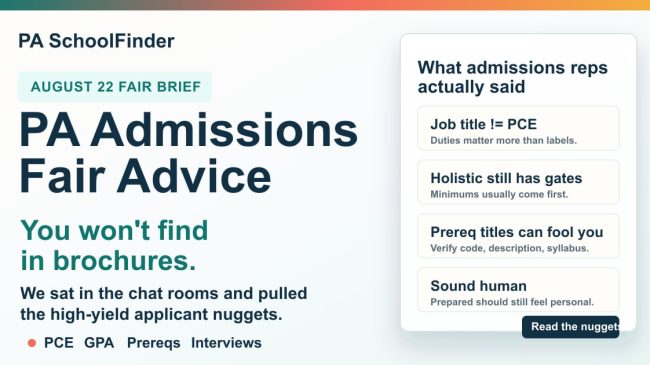
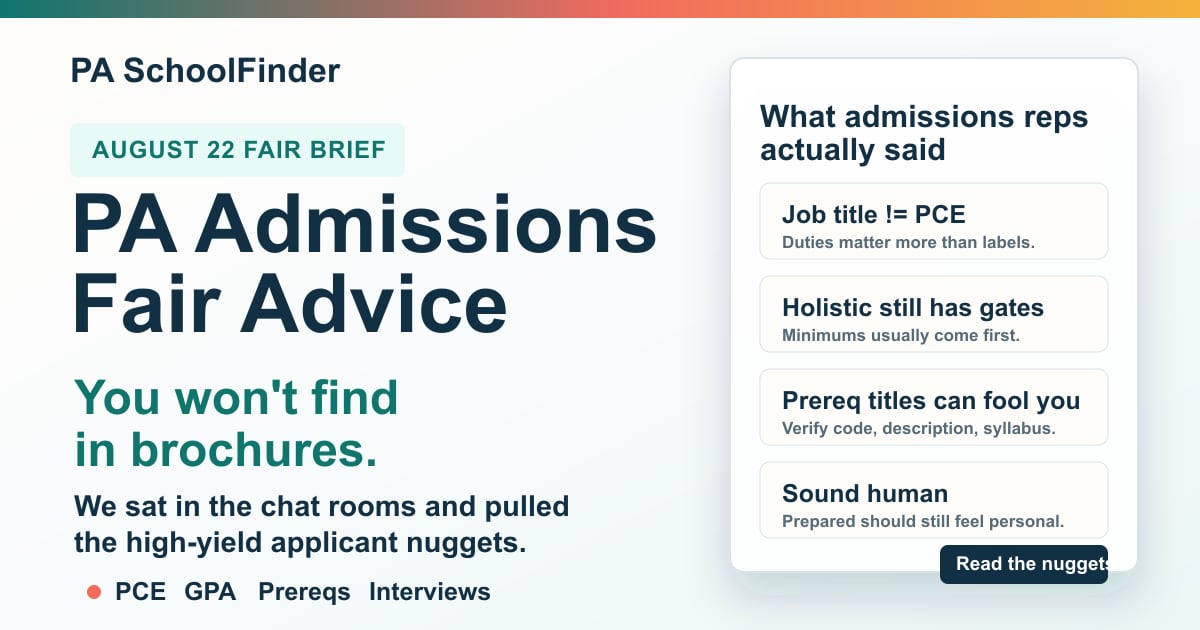
This article is part of our PA Admissions Fair Briefs series, where we attend PA admissions events and pull out the highest-yield advice for busy pre-PAs.
You are trying to finish prerequisites, build patient-care hours, keep CASPA straight, work, shadow, write essays, compare tuition, and somehow decide whether your application is ready.
So we attended the August 22, 2026 PAEA Virtual PA Admissions Fair, sat in the chat rooms, watched what applicants were asking in real time, and pulled out the advice that felt specific enough to help.
Some rooms were quiet. A few were mostly applicant questions with very little response. But several rooms were exactly why these fairs are worth attending: admissions reps answered the questions that usually get buried under polished brochure language.
- Does pharmacy tech count as PCE?
- Does one pending prerequisite hurt me?
- Should I apply early if I am not fully ready?
- Does shadowing matter if I already work with PAs?
- Can a recent science GPA help offset older academic damage?
- Do Canadian or international courses count?
- What makes a low-GPA applicant still worth considering?
- What does “holistic review” mean when programs still publish minimums?
This kind of PA admissions fair advice can change how you build your PA school list, describe your experience, and decide whether an application is ready to submit.
Use this as strategy, not policy. Requirements change. Application cycles change. Chat-room answers should always be checked against the current program website and CASPA listing before you apply.
Start with these takeaways
If you only have a few minutes, start here.
- “Holistic review” does not mean a program ignores its minimum requirements.
- A job title is not enough. Programs want to know what you actually did with patients.
- Pharmacy tech, medical assistant, scribe, and shadowing hours can be classified differently by different programs.
- Applying early helps most when your application is complete, polished, and ready to review.
- Shadowing is more useful when it helps you explain the PA role in your own words.
- Pending prerequisites may be fine at one program and a problem at another.
- International and Canadian coursework rules vary a lot.
- Interview prep should help you sound more like yourself, not like a script.
1. Apply early only when the application is ready
One clear theme from the PAEA/CASPA general information room: rolling admissions and fixed deadlines are not the same thing.
Some programs review applications as they arrive. Others wait until after the deadline. Applying early can help, but only if the application you submit is the version you actually want reviewed.
A rushed application is still a rushed application. Weak experience descriptions, missing pieces, fuzzy prerequisite planning, or half-finished essays do not become stronger because you submitted in May.
The better move:
- Know whether each program reviews on a rolling basis or after the deadline.
- Know whether the deadline means submitted, verified, complete, or ready for review.
- Build in time for CASPA verification.
- Use PA SchoolFinder’s application deadline filters and CASPA participation filters before you pay another fee.
- Submit early when the application shows your best current case.
This matters because programs used different deadline language. DeSales emphasized verification by the deadline. Western Michigan discussed CASPA submission and deadline timing. PAEA reminded applicants that CASPA rollover rules and deadline definitions need careful reading.
Your job is not simply to hit a date. Your job is to understand what “done” means for each program.
2. Holistic review still starts with the published minimums
“Holistic” may be the most misunderstood word in PA admissions.
Applicants sometimes hear holistic and think, “Maybe they will ignore the GPA minimum if the rest of my story is strong.” The fair made a more practical point: holistic review usually begins after the basic requirements are met.
Before you assume your GPA story will carry you, run the numbers honestly in the CASPA GPA Calculator and compare programs by overall GPA requirements.
Several programs talked about holistic review and minimums in the same breath.
Ithaca said it uses a holistic admissions process that considers experiences, attributes, and academic metrics, but applicants still need to meet admission requirements, including minimum GPA requirements.
The University of Mount Saint Vincent gave a similar answer. Recent academic excellence, EMT experience, leadership, service, and career growth can matter, but minimum GPA requirements still open the door to that review.
Ursuline gave a useful answer for borderline applicants. If an applicant meets the 3.0 requirement, they can still be considered. But when the numbers are not doing most of the work, the essay, recommendations, volunteer work, leadership, and career clarity carry more weight.
Minimums get you into the review pool. Holistic review helps the committee understand who you are once you are there.
For applicants with older academic damage, the fair also offered some hope. Western Michigan said it evaluates the CASPA-calculated last-60-credit GPA, not only the old cumulative GPA on a transcript. UNT said an upward science trend can be a positive factor, even if an older science GPA is weaker.
The comeback has to be visible. Do not make an admissions committee dig for your academic growth. Show it with recent science coursework, strong grades, and a concise explanation of what changed.
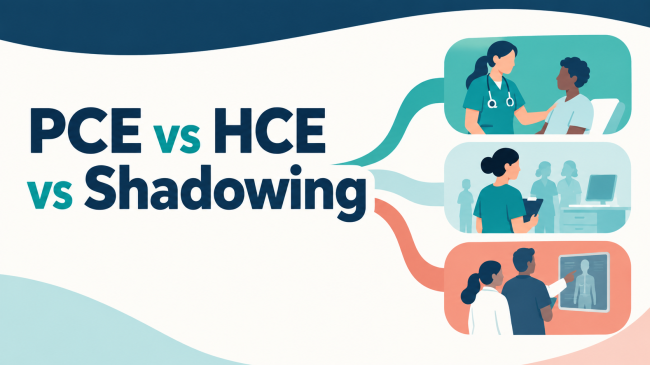
3. Your PCE is the work you did, not the title on your badge
One admissions lesson came up again and again: programs do not simply count a job title. They look at the responsibilities behind it.
You can compare broad patient-care expectations in the PA SchoolFinder healthcare experience filters, but the fair made the more important point. Your description matters.
Marist told applicants that medical assistant experience should be described through direct patient duties such as vitals, wound care, and other hands-on responsibilities. Administrative work was not what they were looking for in that answer.
Jefferson gave one of the clearest pharmacy technician answers. They said the portion of pharmacy tech work involving medication counseling or vaccinations could count differently from clerical or administrative pharmacy work, which should be listed as health-related experience.
MCPHS echoed that idea. Pharmacy tech counted only if the applicant administered medications, gave vaccines, or took blood.
Nova Southeastern reminded applicants to use CASPA’s experience categories carefully. Medical assistant work may be HCE or PCE depending on the job description.
UNE added a helpful note for scribes. Scribing may not build hands-on clinical skills, but it can strengthen medical terminology and interprofessional communication.
This is where applicants leave points on the table. They write:
“Medical assistant, 1,200 hours.”
Admissions needs more than that:
- What did you do with patients?
- Were you directly involved in care?
- Did you take vitals, room patients, assist with procedures, give injections, perform phlebotomy, document, translate, educate, transport, or respond to clinical needs?
- How much of the job was hands-on care and how much was clerical?
- What did the experience teach you about patients, healthcare teams, the PA role, or your own readiness?
Your experience entry should translate your work for the reader. Do not make the title do all the explaining.
4. Shadowing helps when it gives you language for “Why PA?”
Applicants often treat shadowing like a number to collect. PA SchoolFinder has a shadowing requirements filter, but the fair made a better point: shadowing only helps if it teaches you how PAs actually practice.
Michigan State said shadowing is something they look for when screening applicants for interviews. Their rep also said shadowing helps applicants understand the PA profession, which can lead to a stronger interview and a stronger application.
MSU does not have a formal shadowing-hour requirement, but the rep personally advised around 60+ hours because that is roughly what admitted students have on average. Verify that before using it as a target, but the reasoning is useful.
If you work alongside PAs, MSU said that can help you understand the role. The rep still advised getting at least some dedicated PA shadowing.
Ursuline encouraged early pre-PA students to shadow a PA, DO, or MD to make sure the PA route is the right path and to understand what PAs do.
Yale students described shadowing and volunteering as meaningful parts of their own application-building process, while deferring official admissions rules to the program.
The point is not to chase a magic number. Shadow until you can explain the PA role clearly, honestly, and in your own words.
That matters when someone asks, “Why PA?“
5. Prereqs are where small assumptions get expensive
Prerequisite questions came up over and over, and the answers were program specific.
Ithaca said Organic Chemistry I with lab is the prerequisite requirement and told applicants with course-equivalency questions to send the institution name, course code, course description, and preferably a syllabus for review.
Marist said a 4-credit genetics lecture and lab could meet Biology II, but genetics lecture alone would not be enough. They also said online microbiology and biochemistry may be accepted but may not be considered as competitive as on-campus courses.
UNE said Cell Biology with lab may substitute for one required Biology course and Biometry/Biostatistics could satisfy Statistics.
Jefferson recommended Organic Chemistry I and II for a full chemistry sequence when asked about a fundamentals course.
Ursuline said microbiology and genetics could be taken online, and only A&P needed a lab in the context of the question asked.
Western Michigan said prerequisites must be completed by December 31 for that cycle and that prerequisite waivers are extremely rare in PA programs.
Do not assume a course counts because the title sounds close.
If you are unsure, ask the program with the exact course code, course description, and syllabus. Do it early enough that a “no” does not wreck your cycle.
6. Interviews reward preparation, not canned answers
The most direct interview advice came from Southern California University of Health Sciences.
SCUHS stressed that a high GPA and minimum PCE are not enough. Interview preparation can decide whether an applicant gets a seat.
They advised applicants to practice with someone in healthcare or someone older and more experienced, not only peers. Know the program. Know the PA profession. Know how you come across.
They also gave a warning applicants should take seriously: if answers sound scripted or AI-generated, that can hurt you.
That does not mean you should wing the interview. It means you should prepare until your answers sound natural.
Other programs gave useful interview details:
- UNE described two 30-minute interviews with different faculty members plus a 30-minute prompted writing sample, with in-person and virtual options.
- Michigan State described a closed-file one-on-one Zoom interview of about 30 minutes, followed later by a Q&A with current students.
- Yale students described the interview as conversational and said interviewers want to see whether the person in front of them matches the application.
The interview is where the application has to sound like a real person. Practice enough that you can be specific without sounding rehearsed.
7. Gap years are normal, but they need a purpose
UNE gave one of the more applicant-friendly answers of the fair.
They said it is common for PA students to have taken one, a few, or even several gap years. Their accepted students typically range from age 22 to 45. Verify that current range before quoting it as a program statistic, but the broader message is useful.
Gap years can help you:
- Refresh your science knowledge.
- Take preferred coursework.
- Improve your GPA.
- Complete volunteer hours.
- Build clinical experience.
- Add shadowing.
- Clarify why PA is the right fit.
Yale students also framed gap years as time for growth: quality PCE, research, community service, travel, trying new things, and reflecting on the PA path.
You do not need to apologize for taking time. You do need to show what the time did for you.
8. Do not put your finances at risk for application optics
This may have been the most human advice from the fair.
UNE told an applicant that they recommend getting the highest number of patient-care hours possible, but they cannot recommend prioritizing an application over financial security.
That matters.
PA school admissions is competitive. PCE matters. Volunteering and shadowing can help. But applicants are real people with rent, families, transportation, debt, and jobs.
If you are choosing between the experience that looks perfect and the job that keeps your life stable, do not assume the admissions committee needs a fairy-tale version of your path.
Explain your choices. Show your growth. Build what you can, where you can.
9. International and Canadian applicants need program by program answers
The fair made this clear: international and Canadian applicant rules vary a lot. Start with the PA SchoolFinder international applicant filter, then verify each program’s current rules directly.
Jefferson said English-Canadian transcripts can be accepted without credential evaluation and pointed applicants to CASPA transcript guidance.
Ithaca said degree and prerequisite coursework taken outside the U.S. is not accepted, even if made equivalent by a U.S. institution.
WCU told applicants the California program does not accept international degrees, even with evaluation.
Ursuline said a U.S. bachelor’s degree is required.
Marshall said current requirements call for bachelor’s degrees and prerequisites from an accredited U.S. institution.
DeSales said it accepts international students and has had Canadian students, but TOEFL or other details may apply depending on background.
Do not assume one program’s answer applies to another program. Before paying CASPA fees, verify degree, prerequisite, transcript evaluation, visa, TOEFL, and citizenship or permanent residency rules with each program.
10. A few numbers from the fair
Use these as fair-chat notes to verify, not permanent program statistics.
- PAEA said applicants apply to an average of about seven programs, but emphasized mission fit over raw number.
- UNT said it receives 2,000+ applications for approximately 75 seats.
- Jefferson said acceptance across its four programs is approximately 13%.
- Western Michigan gave an approximate acceptance rate of 30%.
- Ithaca described a 12-month clinical phase with well over 1,600 supervised clinical practice hours.
- HPU suggested that an applicant using a new certification to strengthen the file aim for at least 200 hours before submitting.
- The MSU rep personally advised around 60+ PA shadowing hours, while noting MSU has no formal shadowing-hour requirement.
Numbers help you calibrate. They should not send you into a spiral.
Program pages with fair-specific notes
We have added “Straight From the Program – 2026 PAEA Virtual Admissions Fair” notes to the participating PA SchoolFinder program pages where appropriate. Use those boxes to see what came directly from the fair, then verify the current requirements on the program website before applying.
- DeSales University
- High Point University
- Ithaca College
- Marist University
- Marshall University
- MCPHS University – Boston
- MCPHS University – Manchester/Worcester
- Michigan State University
- Nova Southeastern – Fort Lauderdale
- Southern California University of Health Sciences
- Thomas Jefferson – Center City
- Thomas Jefferson – East Falls
- Thomas Jefferson – New Jersey
- University of Mount Saint Vincent
- University of New England
- University of North Texas HSC Fort Worth
- Ursuline College
- West Coast University – California
- Western Michigan University
- Yale University Physician Associate Program
Keep exploring on PA SchoolFinder
Use the fair advice above with the tools applicants need while building a school list:
Final thought
The best applicants are not only collecting requirements. They are learning how admissions committees read an application.
They know the difference between submitted and complete. They describe patient-care duties clearly. They do not assume a course counts because the title sounds close. They use shadowing to understand the profession, not only to fill a line in CASPA. They prepare for interviews until they sound calm, specific, and human.
That is what the August 22 fair made clear.
The hidden work of applying to PA school is translation: turning what you have done into the language admissions committees actually use.
Start there.