
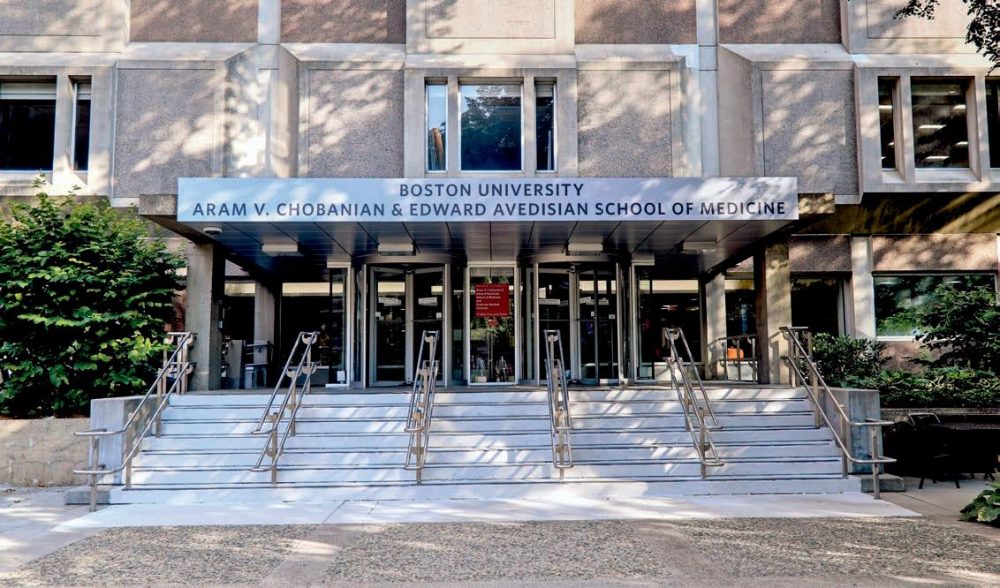
Boston University Chobanian & Avedisian School of Medicine Physician Assistant Program
Boston, Massachusetts · Masters
A closer look
Medical school-based PA program where students take clinical medicine courses alongside second-year medical students, with an optional longitudinal clerkship at CHA.
Mission & approach
The mission of the Boston University School of Medicine Physician Assistant Program is to provide a thorough and innovative education to future physician assistants so that they may go on to provide exceptional care to a diverse population of patients. We are committed to designing a successful model for patient-centered, interprofessional education and practice. We promote professionalism, leadership, and service in our students.
Check my fit with this school
Check three basics
Enter any GPA or patient care hours you know. We’ll compare them with this school’s published numbers. This is a starting point, not an eligibility decision.
The quick check needs JavaScript.
Admissions insights
What this program looks for in applicants
Holistic review of entire file + formal interview; no single element weighted above another. Factors: academic achievement (science GPA 3.2 cutoff, prerequisite completion), 3 LORs (academic, clinical provider, supervisor), personal statement, supplemental application, CASPer (3rd-quartile min), work/life experience, extracurriculars. (bu.edu/paprogram)
Summarized from the program’s admissions information. Confirm current selection criteria with the program.
Program admissions informationHow this program interviews
Candidates who meet admission criteria are formally interviewed by the program's Admissions Committee before being extended an offer of admission, but the site does not describe the interview format or delivery.
Source checked Aug 1, 2026. Interview formats and dates can change between cycles.
Program interview informationAdmissions & prerequisites
Admission requirements
Prerequisite coursework
Semesters/course counts; minimum credits not publishedReview each course, its lab, and the program’s policies. Your links are planning records; the program decides equivalency.
| Course | Credits | Lab | Min grade |
|---|---|---|---|
General Biology or Zoology with lab1 course(s)Course notes & alternativesOne semester. AP credit may substitute if recorded on transcript. Lab may be substituted with another Biology lab (e.g. Microbiology or Genetics). Credit and grade minimum not published. | Not publishedSemesters/course counts; minimum credits not published | Required | Not specified |
Human or Animal Physiology1 course(s)Course notes & alternativesOne semester; 300/400 level preferred, but level not stated as mandatory. Credit, lab, and grade minimum not published. | Not publishedSemesters/course counts; minimum credits not published | Not specified | Not specified |
General Chemistry with lab1 course(s)Course notes & alternativesOne semester. AP credit may substitute if recorded on transcript. Credit and grade minimum not published. | Not publishedSemesters/course counts; minimum credits not published | Required | Not specified |
Organic Chemistry with lab1 course(s)Course notes & alternativesOne semester; course must cover required chemistry foundations. Credit and grade minimum not published. | Not publishedSemesters/course counts; minimum credits not published | Required | Not specified |
Biochemistry1 course(s)Course notes & alternativesOne semester; 300/400 level preferred, not mandatory. Must cover required biochemistry foundations; may not also count as upper-level Biology. | Not publishedSemesters/course counts; minimum credits not published | Not specified | Not specified |
Upper-level Biology3 course(s)Course notes & alternativesThree separate semester courses at 300/400 level or above; do not double-count Physiology or Biochemistry when taken at upper level. Credit/lab/grade rules not published. | Not publishedSemesters/course counts; minimum credits not published | Not specified | Not specified |
Policies that can change your plan
- Course double-counting
- A course cannot satisfy two prerequisite requirements. Upper-level Physiology and Biochemistry cannot also fulfill the 3-course upper-level Biology requirement.
- Course mode
- In-person or hybrid only, with temporary COVID exceptions for courses begun in-person.
- Biology lab alternative
- General Biology/Zoology lab may be substituted with another Biology lab (e.g. Microbiology or Genetics); do not treat those courses as substituting the full Biology course.
Minimum science GPA 3.2; no overall GPA minimum. No numeric patient-care minimum. CASPer required; no GRE or MCAT. Courses must be in-person or hybrid; all prerequisite grades are due by September 1. TOEFL scores are required for second-language English speakers and applicants without four undergraduate years in the US, Canada, or UK: Reading 26, Speaking 26, Writing 28.
When courses must be complete: Prerequisite courses completed with final grades and verified by CASPA by September 1 for August entry.
Dates & application steps
Verified
Know what the total includes
Published cost estimate
Confirm current cohortConfirm rates for your entering cohort
Confirm current costs with the program.
Curriculum & clinical training
Didactic study
Integrated study combines medical and psychological conditions, prevention and team-based learning.
Clinical study
Eleven clerkships include nine required and two elective experiences, with time for thesis preparation.
The program lasts 34 months including breaks and totals 114.5 credit hours. Study is full-time and sequential. Because of curriculum changes, there was no graduating class in 2025.
The admitted class
Class 2023
Published class statisticsThis is the Class of 2023 profile (applications ran April–November 2020), not a 2026 entering class.
Compare published cohorts
| Class | Published GPA | Published science-related GPA | Published experience hours |
|---|---|---|---|
| Class 2023 | 3.48Mean Overall/cumulative GPA | 3.40Mean Science GPA | Not recordedPatient-care hours: not published. |
Published class statistics describe the named cohort or population. They are not admission minimums or acceptance probabilities.
The program’s track record
Graduate outcomes
PANCE pass rates
See first-time program performance with clearly dated national context.
- First-time PANCE pass rate: 100%
- Five-year first-time PANCE pass rate: 95%
Accreditation history
Continued- January 2026Focused visit; Warning Letter
In January 2026, ARC-PA found 14 areas of noncompliance and issued a Warning Letter about institutional oversight, program leadership, faculty sufficiency, curricular implementation, and ongoing self-assessment. The program had to submit reports by March 15, June 1, and September 1, 2026, and a modified self-study report on Standard C1.02 is due December 1, 2026. Results of the later reports are not shown here. Accreditation status remains Accreditation-Continued, with the next review in October 2028.
Sources you can open
Links to the program’s own pages and the official directories we use.
- PA School Finder deadline record
- ARC-PA currently accredited programs — sponsoring-institution directory
- ARC-PA Boston University accreditation history
- PA School Finder contact record
- Boston University Chobanian & Avedisian School of Medicine curriculum
- Boston University Chobanian & Avedisian School of Medicine program page-qualified class profile
- Boston University Chobanian & Avedisian School of Medicine program page
- Boston University Chobanian & Avedisian School of Medicine program page
About the U.S. News rank
The U.S. News PA rank uses the 2025 PA edition, matched to the listed program and campus. It reflects peer-assessed reputation, not admissions odds or a personal fit score. Programs without a separate entry are labeled “Unranked.”
How competitive are you for this program?
Match AI compares your full profile with this program and every other one, then sorts your list into Reach, Target and Safety.