
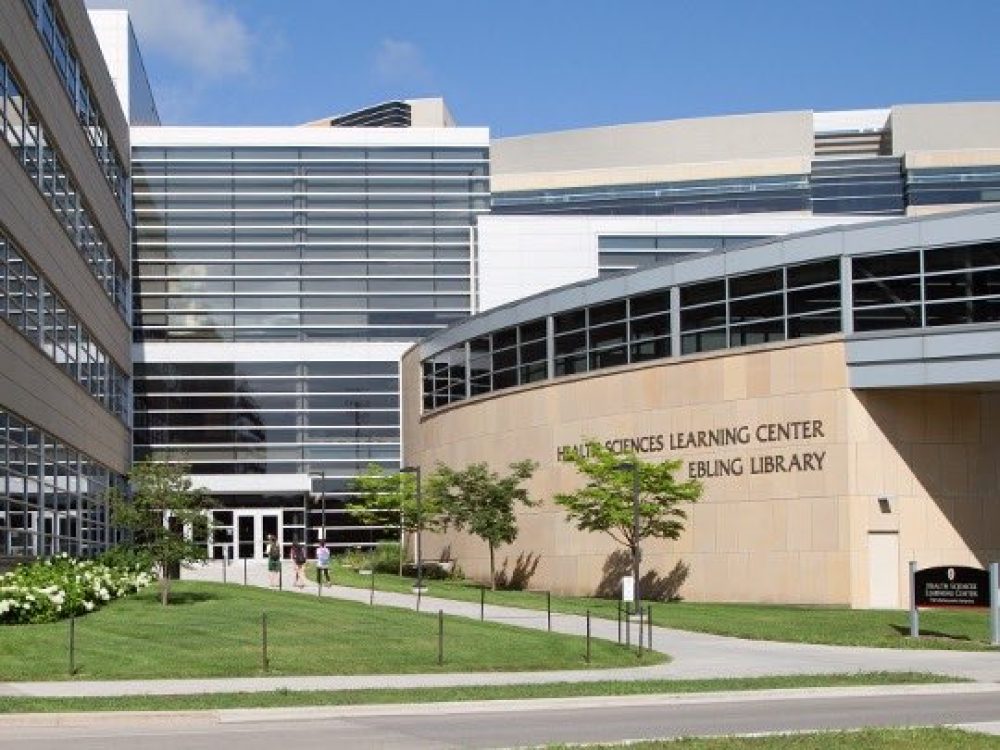
University of Wisconsin – Madison Physician Assistant Program
Madison, Wisconsin · Master of Physician Assistant Studies
Tuition + fees $43,984
2026–2027 · two-year published program charges
A closer look
A 24-month Wisconsin PA program centered on primary care, public service, and preparation for practice across urban and rural communities.
Mission & approach
Educate physician assistants who improve health across Wisconsin and beyond, with attention to primary care, rural communities, and underserved populations.
Check my fit with this school
Check three basics
Enter any GPA or patient care hours you know. We’ll compare them with this school’s published numbers. This is a starting point, not an eligibility decision.
The quick check needs JavaScript.
Admissions insights
What this program looks for in applicants
Goal >=70% of class are Wisconsin residents (Wisconsin Idea / state workforce mission); priority consideration for rural (HRSA), low-income/HPSA, military-affiliated, high financial need, first-generation, and federally recognized tribe applicants (benchmark >=50%; 2024 class 54%); higher cumulative & science GPA preferred; competitive PCE = extensive direct care, esp. having worked with PAs;…
Summarized from the program’s admissions information. Confirm current selection criteria with the program.
Program admissions informationHow this program interviews
UW-Madison spreads admissions interview activities across two separate days in December, including a program-overview day and a day with two 20-minute interviews from separate faculty and staff teams, but its admissions pages do not state whether the sessions are on campus or virtual.
Source checked Aug 1, 2026. Interview formats and dates can change between cycles.
Program interview informationAdmissions & prerequisites
Admission requirements
Science GPA policy & alternatives
You can meet this requirement with either a 3.20 cumulative GPA or a 3.20 GPA on your last 60 credit hours of science coursework.
Prerequisite coursework
Semester courses are listed, but minimum credits for each course are not published — check with the program.Review each course, its lab, and the program’s policies. Your links are planning records; the program decides equivalency.
Courses shown as alternatives in the table are not all required. Confirm the accepted route with the program.
- General Biology two-semester sequence or Organismal Biology, with lab: General Biology two-semester sequence with lab OR Organismal Biology with lab
- Separate Human Anatomy and Physiology or combined two-semester A&P: Human Anatomy + Human Physiology OR Combined Human A&P two-semester sequence
| Course | Credits | Lab | Min grade |
|---|---|---|---|
| General Biology two-semester sequence with lab2 course(s) | Not publishedSemester courses are listed, but minimum credits for each course are not published — check with the program. | Required | C |
| Organismal Biology with lab Accepted alternative to the general-biology sequence; Cellular/Molecular Biology alone is insufficient. | Not publishedSemester courses are listed, but minimum credits for each course are not published — check with the program. | Required | C |
| Microbiology with lab | Not publishedSemester courses are listed, but minimum credits for each course are not published — check with the program. | Required | C |
BiochemistryCourse notes & alternativesCombined Organic/Biochemistry is not equivalent. | Not publishedSemester courses are listed, but minimum credits for each course are not published — check with the program. | Not specified | C |
| Human Anatomy Within three years of matriculation. | Not publishedSemester courses are listed, but minimum credits for each course are not published — check with the program. | Not specified | C |
| Human Physiology Within three years of matriculation. | Not publishedSemester courses are listed, but minimum credits for each course are not published — check with the program. | Not specified | C |
| Combined Human A&P two-semester sequence2 course(s) Both courses must be completed at the same institution; within three years of matriculation. | Not publishedSemester courses are listed, but minimum credits for each course are not published — check with the program. | Not specified | C |
| Statistics1 course(s) | Not publishedSemester courses are listed, but minimum credits for each course are not published — check with the program. | Not specified | C |
| Intro, General, Abnormal or Developmental Psychology1 course(s) | Not publishedSemester courses are listed, but minimum credits for each course are not published — check with the program. | Not specified | C |
Policies that can change your plan
- A&P update
- Approved updates can satisfy the recency rule; expired A&P is not automatically ineligible.
Individual credit minimums are not published. Only Human Anatomy and Physiology have a stated recency rule (three years). Approved Coursera certificates (University of Michigan Anatomy covering all body systems; Duke Physiology) or approved college coursework can update expired A&P. Community or technical-college A&P must be 200-level or higher. A&P updates still in progress when you apply are not counted as outstanding prerequisites. Transcript review is available before you submit your application.
When courses must be complete: At most two outstanding science prerequisites at application; complete before planned matriculation in May.
Dates & application steps
The prior-cycle deadline of 2026-08-01 has passed; the next deadline is not published.
Know what the total includes
Published cost estimate
2026–2027 · two-year published program chargesPublished nonresident full-program tuition
The published figures for residents and nonresidents already combine tuition and university fees for the full program, so no separate fee estimate is added. Living and personal expenses are additional.
Curriculum & clinical training
Didactic preparation
Lectures, laboratories and discussions at the Madison campus build clinical knowledge and patient-care skills.
Clinical rotations
Nine experiences include four six-week core rotations, a six-week elective and four two-week experiences in behavioral medicine, pediatrics, OB-GYN and inpatient care.
This is the 24-month full-time MPAS route. The separate 33-month MPAS–MPH route and distant-campus delivery options are not included here.
The admitted class
Most recently admitted class (year not stated)
Published class statisticsThe program's page gives average cumulative and science GPAs of 3.7 for its most recently admitted class, with no class year or campus breakdown.
Compare published cohorts
| Class | Published GPA | Published science-related GPA | Published experience hours |
|---|---|---|---|
| Most recently admitted class (year not stated) | 3.70Mean Overall/cumulative GPA | 3.70Mean Science GPA | Not recordedPatient-care hours: not published. |
Published class statistics describe the named cohort or population. They are not admission minimums or acceptance probabilities.
The program’s track record
Graduate outcomes
PANCE pass rates
See first-time program performance with clearly dated national context.
- First-time PANCE pass rate: 94%
- Five-year first-time PANCE pass rate: 94%
Accreditation history
ContinuedSources you can open
Links to the program’s own pages and the official directories we use.
- ARC-PA currently accredited programs — sponsoring-institution directory
- UW–Madison PA program
- University of Wisconsin – Madison PA coursework requirements
- University of Wisconsin – Madison curriculum/program program page
- UW–Madison PA tuition and aid
About the U.S. News rank
The U.S. News PA rank uses the 2025 PA edition, matched to the listed program and campus. It reflects peer-assessed reputation, not admissions odds or a personal fit score. Programs without a separate entry are labeled “Unranked.”
How competitive are you for this program?
Match AI compares your full profile with this program and every other one, then sorts your list into Reach, Target and Safety.