
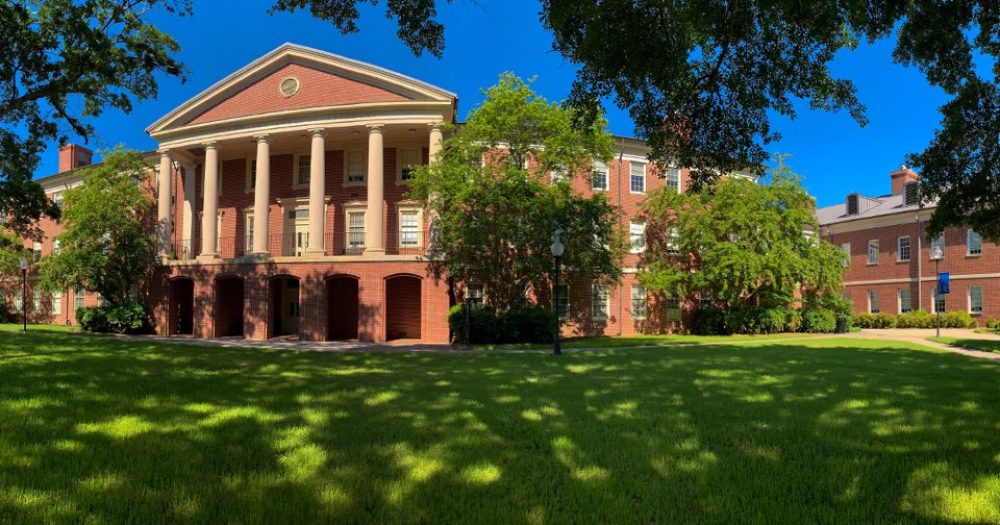
Presbyterian College Physician Assistant Program
Clinton, South Carolina · Master of Science in Physician Assistant Studies
Tuition + fees $109,350
Based on the 2026-27 Year One and Year Two schedules. These are current rates, not a price guarantee for a single cohort.
Check my fit with this school
Check three basics
Enter any GPA or patient care hours you know. We’ll compare them with this school’s published numbers. This is a starting point, not an eligibility decision.
The quick check needs JavaScript.
A closer look
A full-time, in-person, 24-month PA master’s program in Clinton, South Carolina, with a 66-credit didactic phase and 46-credit clinical phase.
Mission & approach
Develop each student’s medical, mental, moral and physical capacities for a lifetime of service to patients and those in need, while empowering the learning community to meet evolving healthcare needs.
Admissions insights
What this program looks for in applicants
Holistic review considers overall and science GPA, healthcare experience and duties, GRE, CASPA essay, recommendations, advanced degrees, community service, PA shadowing, work experience and interview. Applicants with completed prerequisites receive interview preference; Presbyterian College students/graduates meeting all minimums are guaranteed an interview during the active interview period.
Summarized from the program’s admissions information. Confirm current selection criteria with the program.
Program admissions informationHow this program interviews
Interviews are normally in person. A virtual interview requires compelling evidence and approval from the Admissions Director. Traditional, panel, group and multiple mini-interview (MMI) formats are listed, but the program does not describe the stations or sequence. Decisions are normally issued within two weeks.
Source checked Sep 13, 2026. Interview formats and dates can change between cycles.
Program interview informationAdmissions & prerequisites
Admission requirements
Prerequisite coursework
Semester creditsReview each course, its lab, and the program’s policies. Your links are planning records; the program decides equivalency.
| Course | Credits | Lab | Min grade |
|---|---|---|---|
Human Anatomy and Physiology I and IICourse notes & alternativesComplete within seven years; labs required. | 8semester credits | Required | B- |
Organic Chemistry or BiochemistryCourse notes & alternativesOne of the two, with lab, within seven years. | 4semester credits | Required | C- for Organic Chemistry; B- for Biochemistry |
PsychologyCourse notes & alternativesComplete within seven years. | 3semester credits | Not specified | B- |
MicrobiologyCourse notes & alternativesComplete within seven years; lab required. | 4semester credits | Required | B- |
GeneticsCourse notes & alternativesComplete within seven years; lab optional. | 3semester credits | Not required | B- |
General Chemistry I and IICourse notes & alternativesComplete within ten years; labs required. | 8semester credits | Required | B- |
Biology I and IICourse notes & alternativesMammalian, cell or human biology; complete within ten years; labs required. | 8semester credits | Required | B- |
EnglishCourse notes & alternativesNo time limit. | 6semester credits | Not specified | B- |
Advanced mathematicsCourse notes & alternativesStatistics, algebra, calculus, finite math or equivalent; no time limit. | 6semester credits | Not specified | B- |
Humanities and/or social scienceCourse notes & alternativesNo time limit. | 6semester credits | Not specified | B- |
Medical TerminologyCourse notes & alternativesNo time limit. | 1semester credit | Not specified | B- |
Policies that can change your plan
- Course recency
- Seven years for A&P, Organic Chemistry/Biochemistry, Psychology, Microbiology and Genetics; ten years for General Chemistry and Biology; no time limit for English, advanced mathematics, humanities/social science or medical terminology.
- AP/CLEP
- AP prerequisite work may be considered only if your undergraduate institution granted credit, and the program may ask for high-school transcripts or AP scores. The program does not publish its CLEP policy. The professional curriculum grants no advanced standing.
- How experience hours are classified
- You need at least 200 hours in the past five years, in a paid or unpaid role delivering healthcare in a clinical environment. Shadowing does not count. Accepted applicants often have over 1,000 hours with direct patient contact, and the 2024-2025 accepted group averaged about 1,400 clinical hours.
- Recommendations
- Three references, one from each category: (1) someone who knows your work ethic, academic record, volunteer work or other preparation; (2) a currently licensed PA-C, MD or DO; and (3) a doctoral-level professor who taught you, or a second licensed PA-C, MD or DO. Relatives are not allowed. The clinician letter does not have to come from a PA, since an MD or DO also counts.
- Tests and language
- The GRE is required and must be no more than five years old. Send your scores to CASPA using code 2176. The MCAT and PA-CAT are not accepted as admissions tests, although you may upload a PA-CAT score. The program does not clearly address CASPer or TOEFL, so check with them.
- Selection
- Holistic review considers overall and science GPA, healthcare experience and duties, GRE, CASPA essay, recommendations, advanced degrees, community service, PA shadowing, work experience and interview. Applicants with completed prerequisites receive interview preference; Presbyterian College students/graduates meeting all minimums are guaranteed an interview during the active interview period.
- Cost scope
- Tuition is $62,430 for Year One and $46,920 for Year Two, $109,350 in total (2026-27 schedules). Required educational items and program fees are included in tuition. Total cost of attendance, including living costs, is $181,921 on campus or $187,819 commuting. These figures combine schedules from two different years, so they are not a guaranteed bill for a single cohort. A required $100 CastleBranch payment is not added, because the tuition page says screening is included and it is unclear whether the two overlap.
- Matriculation
- Accepted students pay the $1,500 deposit within two weeks and complete immunization, background check, drug screen and health documentation through CastleBranch, including a $100 payment.
- Clinical placement
- The program schedules affiliated rotations; students may state geography/setting preferences but may not arrange their own rotations, and placements may be anywhere in the United States.
- Attendance and work
- Full-time, in-person didactic attendance is generally Monday-Friday, about 9 a.m.-5 p.m. Employment is strongly discouraged and students may not work for the program.
- International applicants
- International students on an F-1 visa are given tuition prepayment instructions, so international applicants appear to be considered. You need a bachelor's degree from a regionally accredited U.S. institution; check with the program to confirm your eligibility.
- Outcomes
- NCCPA report printed October 29, 2025: first-time results are 28/32 (2021), 29/33 (2022), 29/35 (2023), 30/31 (2024) and 34/34 (2025). The five-class total is 150/165 = 90.9%; the latest 2025 first-time rate is 100%. All-taker exam-attempt rates are separate. ARC-PA reports 36 entering in each class: 2023 graduates 35, attrition 1/36 = 2.77%; 2024 graduates 31, attrition 5/36 = 13.89%; 2025 graduates 34, attrition 2/36 = 5.56%. The three-class combined figure of 8/108 = 7.41% is a calculation, not a program-reported number. The program page reports graduation of 97%, 86% and 94%, with 0% deceleration in each year.
You need at least 57 semester credits: A&P I/II with labs (8); Organic Chemistry with lab or Biochemistry with lab (4); Psychology (3); Microbiology with lab (4); Genetics (3); General Chemistry I/II with labs (8); Biology I/II with labs (8); English (6); advanced mathematics (6); humanities/social science (6); medical terminology (1). Most courses require a B-; Organic Chemistry accepts a C-. Time limits vary by subject: seven years, ten years, or none. AP may be considered when your institution awarded credit. The program does not publish whether it accepts CLEP, so confirm with them.
When courses must be complete: You need a regionally accredited U.S. bachelor's degree and all prerequisites completed by July 31 before you start. You may list planned or in-progress prerequisites when you apply, but applicants with completed requirements get interview preference. No maximum number of outstanding courses is published. The GRE, 200 healthcare hours, 50 PA shadowing hours and three recommendations are application requirements.
Dates & application steps
This date has already passed.
Applications are accepted from April 30, 2026 through April 1, 2027, with rolling admission. Submit all of your documents before the April 1, 2027 deadline.
The program usually starts in October. The exact day is not published.
Know what the total includes
Published cost estimate
Based on the 2026-27 Year One and Year Two schedules. These are current rates, not a price guarantee for a single cohort.Tuition is $62,430 for Year One and $46,920 for Year Two, $109,350 in total (2026-27 schedules). Required educational items and program fees are included in tuition. Total cost of attendance, including living costs, is $181,921 on campus or $187,819 commuting. These figures combine schedules from two different years, so they are not a guaranteed bill for a single cohort. A required $100 CastleBranch payment is not added, because the tuition page says screening is included and it is unclear whether the two overlap.
Estimated cost of attendance
Each is a full published estimate including tuition and fees above. Do not add the two totals together.
See additional expenses & assumptions
Private single tuition rate. Required educational items are bundled. Deposit is not double-counted. CastleBranch $100 is shown as unresolved rather than added.
Curriculum & clinical training
12 months / 66 credits
Classroom, laboratory, systems-based clinical medicine, evidence-based medicine, patient evaluation, diagnostics and pharmacology.
12 months / 46 credits
Seven five-credit core rotations, one five-credit elective and a six-credit clinical summative.
The two phases together total 112 credits. Core rotations are family medicine, internal medicine, psychiatry/behavioral medicine, women's health, pediatrics, general surgery and emergency medicine.
The admitted class
Students accepted in the 2024-2025 cycle
Published class statisticsCompare published cohorts
| Class | Published GPA | Published science-related GPA | Published experience hours |
|---|---|---|---|
| Students accepted in the 2024-2025 cycle | 3.70 | 3.60 | 1,400Approximate average clinical hours. The program reports clinical hours, not direct patient care alone. |
Students accepted in the 2024-2025 cycle averaged a 3.7 overall GPA, a 3.6 science GPA, about 1,400 clinical hours and 70+ shadowing hours, and about 12% of applicants were accepted. These describe the class and are not admissions cutoffs. GRE averages are not shown because sources disagree.
Published class statistics describe the named cohort or population. They are not admission minimums or acceptance probabilities.
The program’s track record
Graduate outcomes
PANCE pass rates
See first-time program performance with clearly dated national context.
- First-time PANCE pass rate: 100%
NCCPA report printed October 29, 2025: first-time results are 28/32 (2021), 29/33 (2022), 29/35 (2023), 30/31 (2024) and 34/34 (2025). Five-class aggregate is 150/165 = 90.9%; latest 2025 first-time rate is 100%. All-taker exam-attempt rates are kept separate.
- Five-year first-time PANCE pass rate: 91%
Graduation & attrition
2025 graduating cohort
ARC-PA reports 36 entering in each class: 2023 graduates 35, attrition 1/36 = 2.77%; 2024 graduates 31, attrition 5/36 = 13.89%; 2025 graduates 34, attrition 2/36 = 5.56%. The three-class combined figure of 8/108 = 7.41% is a calculation, not a program-reported number. The program page reports graduation of 97%, 86% and 94%, with 0% deceleration in each year.
Accreditation history
Continued- June 2019Initial provisional accreditation
ARC-PA approved 32 students in the first class, 34 in the second and 36 in the third.
- September 2023Accreditation-Continued
Final Provisional review found continued and sufficient compliance; next comprehensive evaluation September 2033.
- March 2025PANCE analysis accepted
ARC-PA accepted the required analysis and requested no further information.
ARC-PA granted Accreditation-Continued after the September 2023 Final Provisional review. First accredited June 2019; maximum class size 36; next review September 2033. ARC-PA accepted the program’s March 2025 PANCE analysis with no further information requested.
Sources you can open
Links to the program’s own pages and the official directories we use.
- Program-maintained PAEA directory
- ARC-PA currently accredited programs — sponsoring-institution directory
- ARC-PA Presbyterian College accreditation history
- ARC-PA Student Graduation Rate Template
- NCCPA PANCE Exam Performance Summary Report
- Presbyterian PA program overview and contact
- Presbyterian PA mission, goals and outcome metrics
- Presbyterian PA current admissions and requirements
- Presbyterian PA current program details and curriculum
- Presbyterian PA tuition and cost of attendance
- Accepted-student statistics image
About the U.S. News rank
The U.S. News PA rank uses the 2025 PA edition, matched to the listed program and campus. It reflects peer-assessed reputation, not admissions odds or a personal fit score. Programs without a separate entry are labeled “Unranked.”
How competitive are you for this program?
Match AI compares your full profile with this program and every other one, then sorts your list into Reach, Target and Safety.