

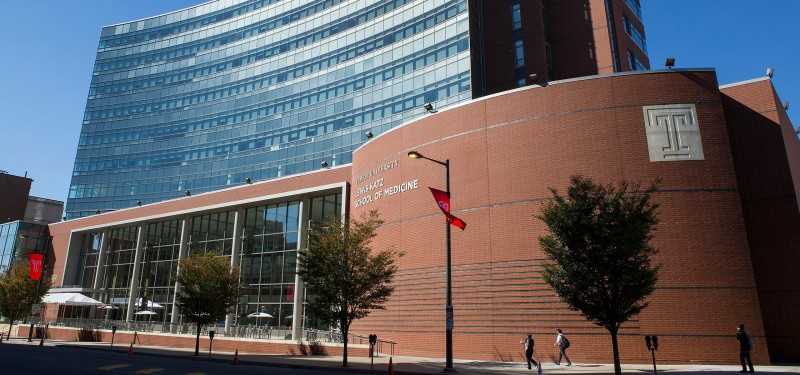
Temple University Lewis Katz School of Medicine Physician Assistant Program
Philadelphia, Pennsylvania · Masters
Tuition + fees $98,748 / $103,545 nonresident
26-month program cost table; academic year not stated
A closer look
A 26-month, 117-credit Philadelphia PA program with a 35-student class and 400 patient-care hours required before matriculation.
Mission & approach
Provide high-quality didactic and clinical education in a collaborative, supportive, empowering environment, developing compassionate, culturally humble PAs who deliver patient-centered, evidence-based, accessible care — emphasis on serving the historically underserved urban community of North Philadelphia.
Check my fit with this school
Check three basics
Enter any GPA or patient care hours you know. We’ll compare them with this school’s published numbers. This is a starting point, not an eligibility decision.
The quick check needs JavaScript.
Admissions insights
What this program looks for in applicants
Verified CASPA + $60 Temple fee; baccalaureate (regionally accredited US/Canada); prerequisites; 3.0 cum/science GPA; 400 PCE hours; 3 LORs; Statement of Goals; resume; US citizen/permanent resident/refugee/asylee only. Recommended: 100 shadowing hrs, 50 community service hrs
Summarized from the program’s admissions information. Confirm current selection criteria with the program.
Program admissions informationHow this program interviews
The PA Program Admissions Committee selects applicants for interview and notifies them by email; interview day includes two personal, one-on-one interviews plus a program overview and a meeting with current students. All interview-day activities and application materials are then reviewed by the Admissions Committee, with admission on a rolling basis.
Source checked Aug 1, 2026. Interview formats and dates can change between cycles.
Program interview informationAdmissions & prerequisites
Admission requirements
Prerequisite coursework
Each prerequisite is one full semester course, typically 3–4 semester hours. Quarter courses need at least 5–6 quarter hours. Exact credits aren't otherwise specified.Review each course, its lab, and the program’s policies. Your links are planning records; the program decides equivalency.
Courses shown as alternatives in the table are not all required. Confirm the accepted route with the program.
- Human anatomy and physiology route: Human Anatomy with lab + Human Physiology with lab OR Combined Human Anatomy/Physiology courses
| Course | Credits | Lab | Min grade |
|---|---|---|---|
General Biology I and II with labs2 course(s)Course notes & alternativesTwo-course science-major sequence with labs. Each course is typically 3–4 semester hours; no exact individual course minimum is published. | Not publishedEach prerequisite is one full semester course, typically 3–4 semester hours. Quarter courses need at least 5–6 quarter hours. Exact credits aren't otherwise specified. | Required | C |
General Chemistry I and II with labs2 course(s)Course notes & alternativesTwo-course science-major sequence with labs. Each course is typically 3–4 semester hours; no exact individual course minimum is published. | Not publishedEach prerequisite is one full semester course, typically 3–4 semester hours. Quarter courses need at least 5–6 quarter hours. Exact credits aren't otherwise specified. | Required | C |
Organic Chemistry with lab1 course(s)Course notes & alternativesOne prerequisite course; lab required. | Not publishedEach prerequisite is one full semester course, typically 3–4 semester hours. Quarter courses need at least 5–6 quarter hours. Exact credits aren't otherwise specified. | Required | C |
Biochemistry1 course(s)Course notes & alternativesOne course; no lab requirement stated. | Not publishedEach prerequisite is one full semester course, typically 3–4 semester hours. Quarter courses need at least 5–6 quarter hours. Exact credits aren't otherwise specified. | Not specified | C |
| Human Anatomy with lab1 course(s) Anatomy: one course in the separate route. Two combined Human A&P courses can replace separate Anatomy and Physiology. | Not publishedEach prerequisite is one full semester course, typically 3–4 semester hours. Quarter courses need at least 5–6 quarter hours. Exact credits aren't otherwise specified. | Required | C |
| Human Physiology with lab1 course(s) Physiology: one course in the separate route. Two combined Human A&P courses can replace separate Anatomy and Physiology. | Not publishedEach prerequisite is one full semester course, typically 3–4 semester hours. Quarter courses need at least 5–6 quarter hours. Exact credits aren't otherwise specified. | Required | C |
| Combined Human Anatomy/Physiology courses2 course(s) Alternative route: two combined courses may substitute for separate Human Anatomy and Human Physiology. Lab treatment for this combined route is not specified; confirm course equivalence. | Not publishedEach prerequisite is one full semester course, typically 3–4 semester hours. Quarter courses need at least 5–6 quarter hours. Exact credits aren't otherwise specified. | Not specified | C |
Statistics1 course(s)Course notes & alternativesOne course; the typical semester or quarter course length applies. | Not publishedEach prerequisite is one full semester course, typically 3–4 semester hours. Quarter courses need at least 5–6 quarter hours. Exact credits aren't otherwise specified. | Not specified | C |
Psychology1 course(s)Course notes & alternativesOne course; exact type and credits are not specified. | Not publishedEach prerequisite is one full semester course, typically 3–4 semester hours. Quarter courses need at least 5–6 quarter hours. Exact credits aren't otherwise specified. | Not specified | C |
Medical Terminology1 course(s)Course notes & alternativesOne course; exact credits are not specified. | Not publishedEach prerequisite is one full semester course, typically 3–4 semester hours. Quarter courses need at least 5–6 quarter hours. Exact credits aren't otherwise specified. | Not specified | C |
Two or more approved upper-science elective courses2 course(s)Course notes & alternativesChoose at least two distinct courses from Genetics, Molecular Biology, Immunology, Microbiology, and Cell Biology. These are electives, so you do not need all five. A single course cannot satisfy multiple prerequisites. Typical courses are 3–4 semester hours; the exact minimum is not published. Check with the program. | Not publishedEach prerequisite is one full semester course, typically 3–4 semester hours. Quarter courses need at least 5–6 quarter hours. Exact credits aren't otherwise specified. | Not specified | C |
Policies that can change your plan
- Semester courses typically three to four credits
- Confirm details for the current cycle with the program.
- Quarter courses: at least five to six quarter hours
- Confirm details for the current cycle with the program.
- A grade below C is not accepted.
- Confirm details for the current cycle with the program.
- All science and math courses within 10 years of June enrollment
- Confirm details for the current cycle with the program.
- At least four science courses within 4 years of June enrollment
- Confirm details for the current cycle with the program.
- Max two outstanding at application
- Confirm details for the current cycle with the program.
- Complete by matriculation
- Confirm details for the current cycle with the program.
- No double counting courses
- Confirm details for the current cycle with the program.
- Two or more upper science electives. Check with the program.
- Confirm details for the current cycle with the program.
- Lab requirement for combined A&P is not specified
- Confirm details for the current cycle with the program.
- Traditional MMS (Master of Medical Science) track only
- Confirm details for the current cycle with the program.
This applies to the traditional MMS (Master of Medical Science) admissions track only. Applicants must complete at least two distinct upper-level science courses, not all of the listed subjects. Lab treatment for combined A&P is unspecified.
When courses must be complete: A complete, verified CASPA application and the $60 graduate fee are due January 15 for June enrollment. Applying by December 1 of the prior year is recommended.
Dates & application steps
CASPA application deadline is January 15 for June matriculation.
This is the expected start of the entering class.
Know what the total includes
Published cost estimate
26-month program cost table; academic year not stated$61,065 Year 1 + $42,480 Year 2 · Nonresident full-program tuition only, summed from the yearly amounts in the 26-month cost table (academic year not stated). Future rates may change.
The cost table's amounts are tuition. Required fees aren't published, so they are unknown, not zero. Resident and nonresident amounts differ.
Curriculum & clinical training
Preclinical instruction
69 credits of coursework prepare students for clinical practice.
Clinical training
48 credits of supervised clinical education use Temple’s health system and clinical partners.
The Philadelphia program is 26 months and 117 credits. A separate phase duration is not given, so no month split is listed.
The admitted class
Published class statistics describe the named cohort or population. They are not admission minimums or acceptance probabilities.
The program’s track record
Graduate outcomes
PANCE pass rates
See first-time program performance with clearly dated national context.
- First-time PANCE pass rate: 91%
Class of 2025: 91% first-time pass rate (29 of 32 first-time takers). Earlier classes: 2024 76%, 2023 90%, 2022 89%, 2021 90%. The five-year first-time rate is 87%, found by adding up passers and takers across the 2021-2025 classes (139 of 160).
- Five-year first-time PANCE pass rate: 87%
Accreditation history
ContinuedSources you can open
Links to the program’s own pages and the official directories we use.
- Program program page
- Lewis Katz School of Medicine Traditional MMS PA Requirements
- Program program page for final data cleanup
- ARC-PA currently accredited programs — sponsoring-institution directory
- Temple University Lewis Katz School of Medicine curriculum
About the U.S. News rank
The U.S. News PA rank uses the 2025 PA edition, matched to the listed program and campus. It reflects peer-assessed reputation, not admissions odds or a personal fit score. Programs without a separate entry are labeled “Unranked.”
How competitive are you for this program?
Match AI compares your full profile with this program and every other one, then sorts your list into Reach, Target and Safety.