
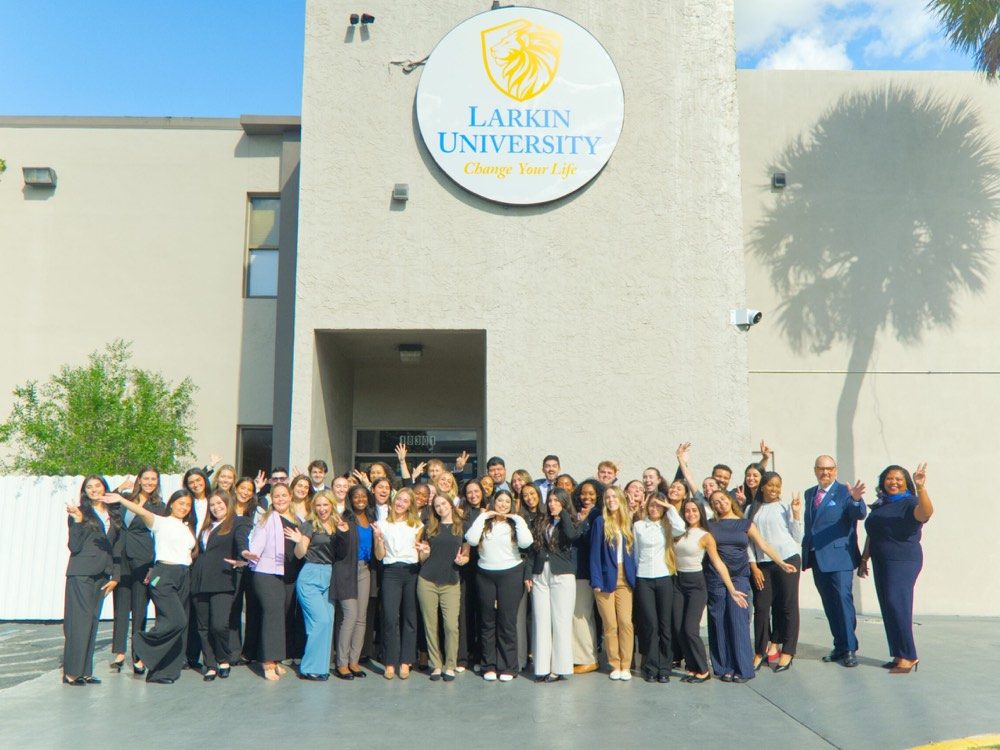
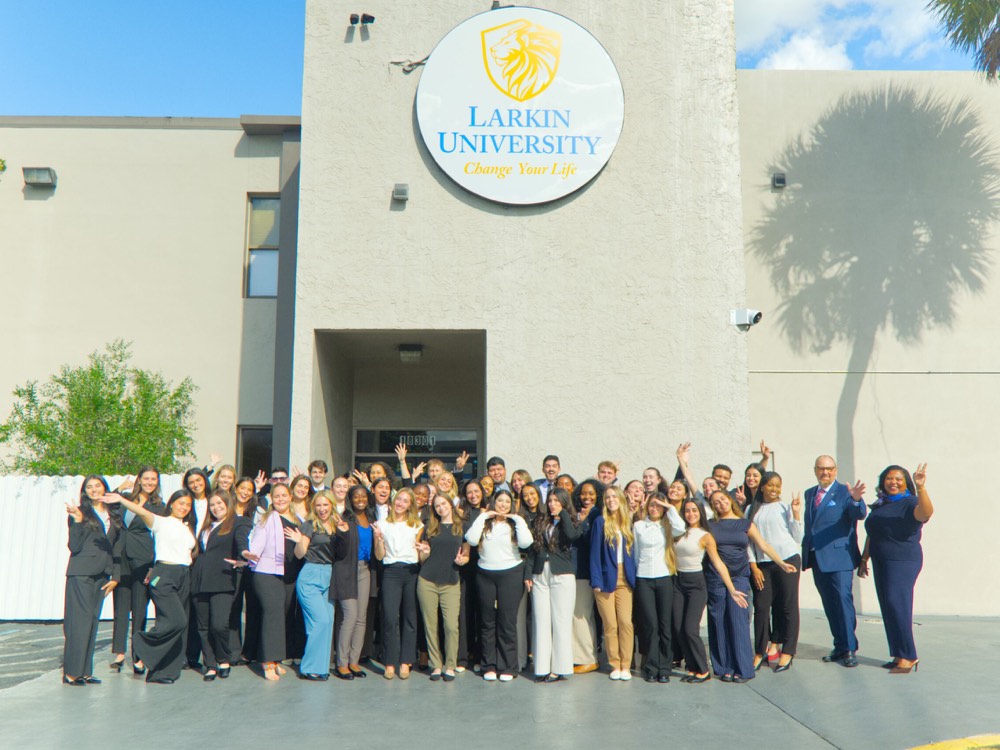
Larkin University Physician Assistant Program
Miami Gardens, Florida · Master of Science in Physician Assistant Studies
Tuition + fees $103,650
Current seven-term estimate; cohort year not stated
A closer look
A 28-month, 128-credit PA program in Miami Gardens, Florida, focused on South Florida’s urban and rural communities. Training combines campus coursework, supervised clinical rotations and a final summative phase.
Mission & approach
Prepare skilled, compassionate PAs to serve the health needs of South Florida’s urban and rural communities.
Check my fit with this school
Check three basics
Enter any GPA or patient care hours you know. We’ll compare them with this school’s published numbers. This is a starting point, not an eligibility decision.
The quick check needs JavaScript.
Admissions insights
What this program looks for in applicants
Favorable consideration for master’s/doctoral degree holders, Larkin graduates and Central/South Florida residents. Prior healthcare experience, especially 1,000 direct-care hours, is recommended. Personal statement, professional recommendations, technical standards and interview contribute to review.
Summarized from the program’s admissions information. Confirm current selection criteria with the program.
Program admissions informationHow this program interviews
Onsite panel and group interviews. The program gives January–March as the annual interview window; no exact day is published.
Source checked Sep 13, 2026. Interview formats and dates can change between cycles.
Program interview informationAdmissions & prerequisites
Admission requirements
Overall GPA exception pathway
The admissions page prefers a 3.0 cumulative GPA, while the 2025–2026 student handbook and university catalog prefer 2.9, and 2.9 is also listed as a minimum elsewhere. No single cumulative cutoff is stated consistently, so ask admissions which applies to your cycle.
Science GPA policy & alternatives
The admissions page calls a 3.0 science GPA preferred, while the 2025–2026 handbook and catalog describe 3.0 as a minimum. Confirm whether it is mandatory for your cycle.
Prerequisite coursework
The program lists semesters; credit values are in each course's notes.Review each course, its lab, and the program’s policies. Your links are planning records; the program decides equivalency.
| Course | Credits | Lab | Min grade |
|---|---|---|---|
Human AnatomyCourse notes & alternativesThe catalog and handbook require Anatomy with lab separately from Physiology, while the program website lists Human Anatomy and Physiology together with lab. Each component is 4 credits. Confirm that a combined sequence satisfies the requirement. | Not publishedThe program lists semesters; credit values are in the notes. | Required | C |
Human PhysiologyCourse notes & alternativesA separate companion to Human Anatomy in the catalog and handbook; 4 credits with lab. Do not count a combined sequence twice. | Not publishedThe program lists semesters; credit values are in the notes. | Required | C |
General Biology I and IICourse notes & alternativesBoth courses with labs; 8 credits total. | I and IIThe program lists semesters; credit values are in the notes. | Required | C |
General Chemistry I and IICourse notes & alternativesTwo semesters with labs; 8 credits total. | 2 semestersThe program lists semesters; credit values are in the notes. | Required | C |
Inorganic OR Organic ChemistryCourse notes & alternativesChoose either route. Biochemistry is a separate requirement, not a substitute. Organic Chemistry is 3 credits, and the program also expressly accepts Inorganic Chemistry. | 1 semesterThe program lists semesters; credit values are in the notes. | Required | C |
BiochemistryCourse notes & alternativesRequired as a separate course, with or without a lab; 3 credits. | 1 semesterThe program lists semesters; credit values are in the notes. | Not required | C |
MicrobiologyCourse notes & alternativesMust include a lab; 3 credits. The program does not state a semester-hour total. | 1 semesterThe program lists semesters; credit values are in the notes. | Required | C |
College MathematicsCourse notes & alternativesThe student handbook requires one semester of College Math (Precalculus or Calculus, 3 credits). Do not assume a specific algebra course qualifies. | 1 semesterThe program lists semesters; credit values are in the notes. | Not specified | C |
Statistics OR CalculusCourse notes & alternativesOne alternative requirement; Statistics is 3 credits. Confirm whether Calculus can also satisfy College Math rather than assuming one course counts twice. | 1 semesterThe program lists semesters; credit values are in the notes. | Not specified | C |
Psychology OR Anthropology OR SociologyCourse notes & alternativesOne course in General, Developmental, or Abnormal Psychology, Anthropology, or Sociology (3 credits). No lab is required. | 1 courseThe program lists semesters; credit values are in the notes. | Not specified | C |
Policies that can change your plan
- Five-year science rule
- The admissions page uses both "preferred" and "required" wording, and the catalog requires science prerequisites within five years. Confirm the rule that applies and any exceptions before you apply.
- Course completion
- All prerequisites must be complete before you start. Conditional acceptance is possible, with up to two courses still pending.
- AP/CLEP and online coursework
- Whether AP/CLEP credit counts for PA prerequisites is not published, and no online-coursework policy is given. The university accepts CLEP for Pharmacy, but this is not stated for PA, so ask admissions.
- Patient-care roles
- Program examples include RN, paramedic, EMT, physical therapist, nursing assistant, medical assistant, clinical research coordinator, health educator and scribe. At least 1,000 direct-care hours completed before applying are favored, not required; verify the duties of any broader healthcare role.
- Review timing
- The program website says applications are reviewed November–December, with interviews January–March. Regular (not rolling) admission after the deadline is also listed, and rolling admission is not stated. Ask admissions about review timing.
- Employment
- Working while enrolled is prohibited. There is no part-time or distance option.
- Clinical placements
- The program secures clinical sites and preceptors; students do not have to find their own. All sites are in the United States. Clinical travel is included as a fee estimate, but the maximum placement distance is not published.
- Advanced standing
- No professional-program advanced standing or substitution based on prior courses or clinical experience.
- After acceptance
- $1,000 non-refundable deposit, credited toward tuition, due as specified in the offer letter. Background check, drug screen and technical standards apply.
- Health and housing
- Active health insurance and updated immunizations are required. There is no on-campus housing. The cost table lists student accident coverage, which does not mean comprehensive health insurance is provided.
- Financial aid
- The PA program is not yet eligible for federal Title IV student aid, and the university's approval for other degrees does not include PA. You can explore private loans and possible scholarships; future federal approval is not guaranteed.
- Contact
- Admissions: [email protected], 305-760-7488. Another page lists 305-760-7480, so confirm the number. Financial aid: [email protected], 305-760-7513.
A C or better is required in every prerequisite. Complete all prerequisites before you start; up to two may still be outstanding. Science courses must be recent: the admissions page says within five years is "preferred" in one place and "required" in another, and the 2025–2026 catalog requires it. Plan for the stricter five-year rule and confirm any exceptions. Credit values are in each course's notes. No policy on AP/CLEP, online courses, online labs, or pass/fail is published for PA prerequisites.
When courses must be complete: Complete your bachelor's degree and all prerequisites before you start; up to two prerequisites may still be pending. Your CASPA application must be Verified by December 1, 2026 for the October 2027 class, and the university processing-fee verification form must be uploaded before you submit CASPA.
Dates & application steps
Your CASPA application must be Verified by December 1, 2026 for October 2027 entry; the program website also gives December 1 each year. Upload the supplemental processing-fee verification form to CASPA before you submit. No separate supplemental deadline is published.
The exact day is not published.
The program gives an annual pattern. An exact upcoming interview date is not listed, so check with the program.
The program website says November–December, while another listing says regular review after the deadline. Confirm the timing.
4–5 p.m. Eastern Time.
4–5 p.m. Eastern Time.
10 a.m.–2 p.m. Eastern Time. This is a university event, not a PA admissions fair.
Know what the total includes
Published cost estimate
Current seven-term estimate; cohort year not statedTuition is $80,528 and required fees are $23,122, for a total of $103,650. These are estimates from a cost table that does not state a cohort year, not a guaranteed October 2027 price. Living costs are estimated separately at up to $36,180 for 12 months (2025–2026); a total for the full 28 months is not published.
See additional expenses & assumptions
Tuition is $11,504 per term across seven billing terms ($80,528). Fees by term: $7,804, $1,084, $1,084, $5,180, $2,160, $2,810 and $3,000 ($23,122). Tuition plus fees by year: $44,484, $44,662 and $14,504 ($103,650). The $1,000 deposit is credited to tuition and is not added again. The $36,180 living-cost maximum is for 2025–2026 only and is additional, so do not multiply it into a 28-month total. Costs may change; ask for a cohort-specific quote and for health-insurance costs.
Curriculum & clinical training
Didactic
Four campus semesters with early clinical exposure.
Clinical
Family medicine, emergency medicine, internal medicine, surgery, pediatrics, women’s health, behavioral/mental health and two electives.
Summative
Return to campus for comprehensive assessment, capstone/exponential experience and PANCE preparation.
The program is 28 months and 128 credits (73 didactic plus 55 clinical/summative). Clinical training is six five-week rotations, one ten-week Family Medicine rotation, and two electives, but the catalog gives different lengths for Surgery and the electives, so rotation lengths are unconfirmed. The program arranges your clinical placements. To progress and graduate you need a 2.5 GPA, completion of required courses and competencies, and a summative assessment; these are separate from admissions GPA policies.
The admitted class
Matriculant GPA, experience averages, and attrition for a specific cohort are not published. The estimated class size for October 2027 is 50, which is also the ARC-PA maximum. The first cohort was announced for October 2025. Program goals, such as 90% graduation and 70% of students from Central/South Florida, are targets, not results.
Published class statistics describe the named cohort or population. They are not admission minimums or acceptance probabilities.
The program’s track record
Graduate outcomes
PANCE pass rates
See first-time program performance with clearly dated national context.
- First-time PANCE pass rate: No graduates yet
No graduates/PANCE results yet; first graduates expected 2028. This is a future expectation, not a reported PANCE year.
First-time program results are not yet available; no graduates have been reported.
- Five-year first-time PANCE pass rate: No graduates yet
Five-year first-time results are not yet available.
Accreditation history
Provisional- June 2025Accreditation-Provisional granted
Six cited standards concerned publication of assessment/graduation policies, board-certified preceptors, assessment alignment/timeliness and timely medical-director appointment. Maximum class size 50.
- April 2026Further information requested
No further information was required for standards A3.15b/c. Further evidence on standards B3.06a and B4.01a/b was due August 3, 2026, and website information was due July 3, 2026. The next review is set for April 2028. The outcome is not listed.
Provisional accreditation, first granted June 2025, with a maximum class size of 50 and the next review in April 2028. In April 2026 ARC-PA requested further information on preceptor certification and assessment alignment/timeliness (due August 3, 2026), and a website report was due July 3, 2026. Those dates have passed, and the outcome is not yet listed.
Sources you can open
Links to the program’s own pages and the official directories we use.
- Larkin clinical
- Larkin student
- Larkin paea
- ARC-PA currently accredited programs — sponsoring-institution directory
- Larkin accreditation
- Larkin overview
- Larkin admissions
- Larkin curriculum
- Larkin faq
- Larkin costs
- Larkin timeline
- Larkin catalog
About the U.S. News rank
The U.S. News PA rank uses the 2025 PA edition, matched to the listed program and campus. It reflects peer-assessed reputation, not admissions odds or a personal fit score. Programs without a separate entry are labeled “Unranked.”
How competitive are you for this program?
Match AI compares your full profile with this program and every other one, then sorts your list into Reach, Target and Safety.