Short answer: there is no PA school that is objectively “easy” to get into. The useful version of this question is: Which accredited programs have published requirements that create fewer barriers for my particular profile?
For one applicant, that may mean no GRE. For another, it means no minimum patient-care hours, a lower GPA screen, no supplemental application, or a mission that strongly matches years of service. Those are measurable differences. “Easy” is not.
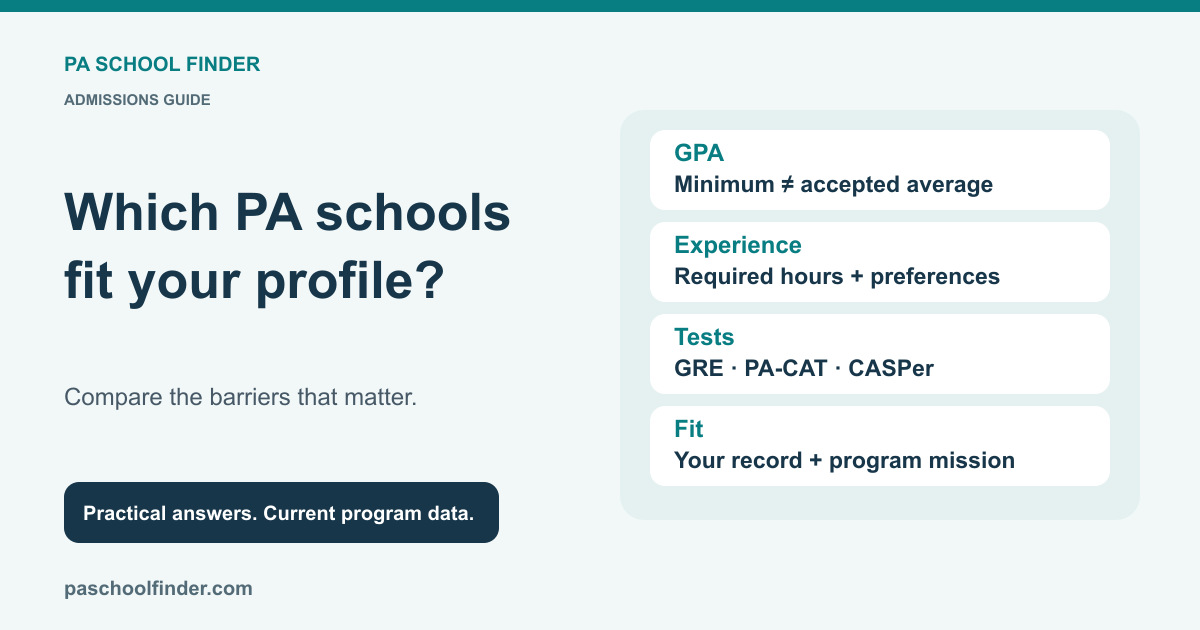
What makes a PA program lower barrier?
- GPA: a lower cumulative or science minimum, or documented consideration of recent coursework.
- Experience: no required patient-care minimum, or a broad definition of qualifying experience.
- Testing: no GRE, PA-CAT, or CASPer requirement.
- Application friction: no supplemental application or extra fee.
- Prerequisites: reasonable course-expiration and minimum-grade rules for your transcript.
- Mission fit: selection priorities that your record genuinely supports.
No single program will necessarily be flexible in every category. A school with a 3.0 GPA minimum may expect substantial patient care. A no-GRE school may have a narrow prerequisite list. Compare the complete rule set.
Which PA programs publish lower GPA minimums?
The live comparison below separates minimum GPA from the accepted-student average. A minimum is a screen, not the profile of the typical admitted student. Use the middle summary card to focus on programs with a published minimum cumulative GPA of 3.0 or below.
“Not published” does not mean “no minimum,” and a 3.0 minimum does not mean the incoming class averages 3.0. Confirm the current admissions page before applying.
Which lower-barrier path fits your profile?
If your GPA is the weak point
Start with the live GPA comparison and our guide to applying with a lower GPA. Look for programs that discuss upward trends, recent credits, or holistic review—but do not apply below a hard cutoff unless the program documents an exception.
If you have limited patient-care experience
Use the live list of PA programs without a required healthcare-experience minimum. Then read the notes carefully: “no minimum” can coexist with a preference for experienced applicants.
If standardized tests are the obstacle
Compare programs that do not require the GRE and the separate PA-CAT requirement list. Never assume “test optional” and “not required” mean the same thing.
If application cost and time are tight
Our live list of programs without a supplemental application can reduce extra forms and fees. Still check CASPA, school, and interview costs before calling an application inexpensive.
What should you ignore on “easiest PA school” lists?
- A percentage without a named entering class and defined denominator.
- A seat-to-application ratio labeled as an acceptance rate.
- A low minimum GPA presented as the average accepted GPA.
- An old test or experience requirement without a current official source.
- A multi-campus university treated as one PA program.
- A claim that provisional accreditation means admission will be easier.
Our guide to PA school acceptance rates explains why these shortcuts can be misleading.
How do you build a realistic lower-barrier school list?
- Calculate your CASPA cumulative and science GPAs.
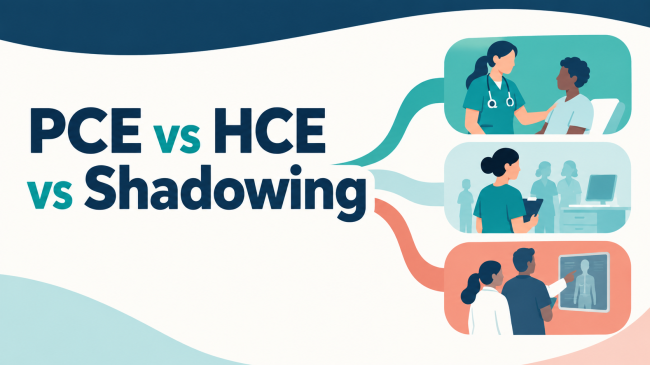
- Classify every experience correctly as PCE, HCE, shadowing, service, or employment.
- Remove programs where you miss a hard requirement.
- Choose the barrier you actually need to reduce.
- Compare your profile with accepted-student data and program selection factors.
- Confirm every requirement on the official program page before submitting.
If you want a faster starting point, use PA Program Match or paste your profile into PA Program Match AI. The goal is not to find a mythical easy school. It is to stop wasting applications on poor fits.
Frequently asked questions
What is the easiest PA school to get into with a low GPA?
No program can be named universally easiest. Start with schools whose published minimums you meet, then compare accepted-student averages, recent-credit policies, mission fit, and the rest of your application.
Are PA schools with no GRE easier?
They remove a testing barrier, but may attract more applicants or weigh GPA, experience, essays, and interviews more heavily. No GRE is a requirement difference, not evidence of easier admission.
Is a newer PA program easier to get into?
Possibly fewer people know about it, but that does not establish easier selection. Review seat count, location, requirements, accreditation, cost, and official selection criteria instead of guessing.
Your strongest list starts with programs whose requirements fit your record.
How this guide is maintained: The GPA comparison reads the published directory on page load. Lower published barriers are not admission probabilities. Linked program profiles and official admissions policies should be checked for the entering cohort.
Stephen Pasquini, PA-C
About PA School Finder and our editorial approach