Short answer: most entry-level PA programs require a bachelor’s degree, specific prerequisite courses, a competitive GPA, letters of recommendation, and a complete CASPA application. Many also require or prefer patient-care experience, a supplemental application, a standardized assessment, and an interview. The exact combination is program specific.
That last sentence matters. There is no universal PA school checklist that makes you eligible everywhere. I use a national checklist to plan, then a program-by-program grid before submitting.
What are the usual PA school requirements?
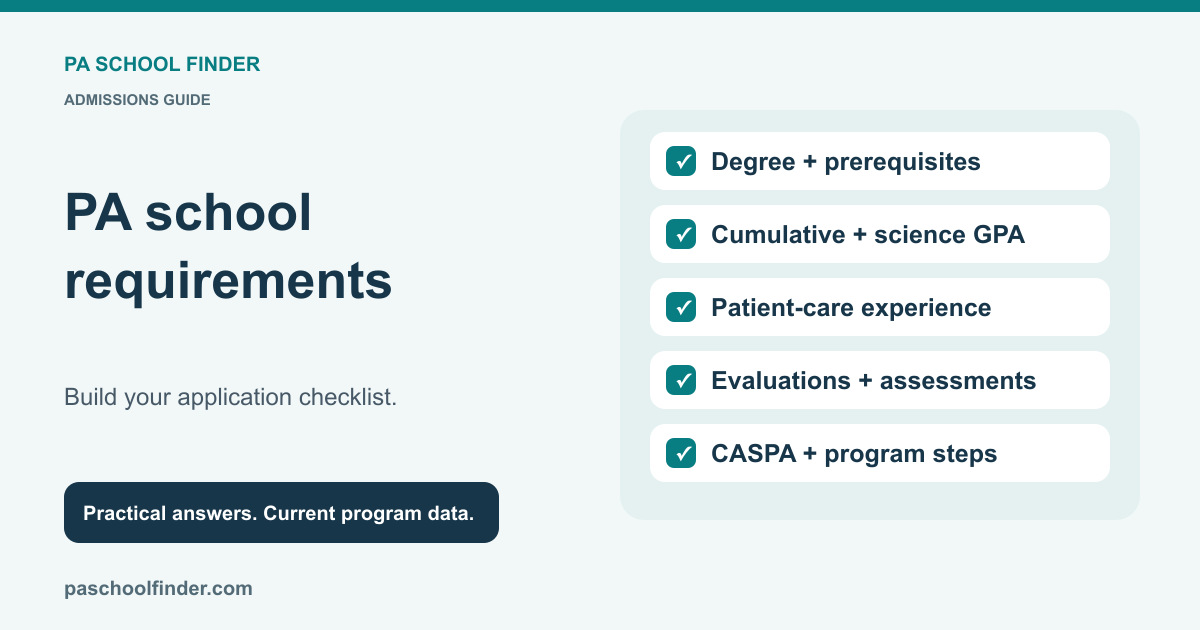
- Degree: a completed bachelor’s degree before matriculation, with limited direct-entry exceptions.
- Prerequisite courses: commonly anatomy, physiology, microbiology, chemistry, statistics, psychology, and sometimes organic chemistry or biochemistry.
- GPA: published cumulative, science, prerequisite, or recent-credit minimums.
- Experience: patient-care experience, healthcare experience, shadowing, service, or a combination.
- Application: CASPA materials plus any program-specific supplemental requirements.
- Evaluations: letters from the evaluator types the program requests.
- Assessments: GRE, PA-CAT, or CASPer at programs that require them.
- Interview: traditional, panel, multiple mini interview, virtual, or in-person formats.
- Eligibility details: citizenship, international-coursework, technical-standard, background-check, and campus-specific rules.
Do you need a bachelor’s degree for PA school?
Most entry-level master’s PA programs require a bachelor’s degree before the program begins. Your major usually matters less than completing the right prerequisites and building a record that shows academic readiness.
Students who know early may consider a direct-entry or combined PA pathway. These programs have their own progression rules and should not be confused with the usual post-baccalaureate CASPA route.
Which prerequisite courses do PA schools require?
Common prerequisites include anatomy and physiology with labs, microbiology with lab, general chemistry, statistics, psychology, and medical terminology. Organic chemistry, biochemistry, genetics, nutrition, and additional biology vary much more.
Check more than the course title. Programs may specify credits, labs, minimum grades, online-course policies, AP/CLEP acceptance, and expiration windows. A course that satisfies one school may not satisfy another.
What GPA do you need for PA school?
Many programs publish a minimum cumulative or science GPA near 3.0, but the admitted class may average substantially higher. Some also calculate a prerequisite GPA or review the last 30–60 credits.
CASPA recalculates coursework and includes all grades from repeated courses. Use our free CASPA GPA calculator and review the official CASPA GPA calculation guide.
How much patient-care experience do PA schools require?
Requirements range from no numeric minimum to thousands of hours. Just as important, programs classify roles differently. Work accepted as direct patient care at one school may be healthcare experience at another.
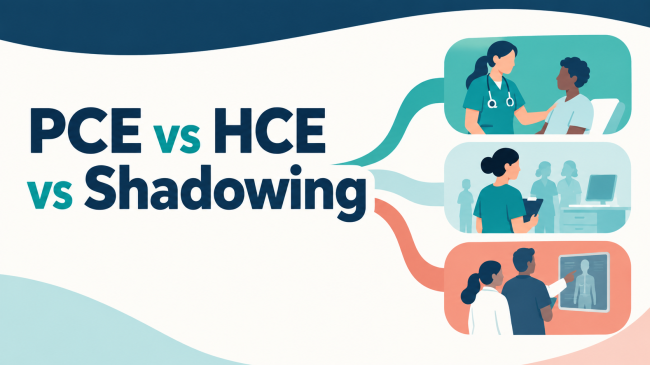
Use our PCE versus HCE versus shadowing guide and the live list of programs without a required experience minimum. “No minimum” does not mean experience is unimportant.
Do PA schools require the GRE, PA-CAT, or CASPer?
There is no universal test. Many programs do not require the GRE, while others require the GRE, PA-CAT, CASPer, or a program-specific combination. Verify the rule for your application cycle and campus.
Compare our current lists of PA programs without the GRE and programs with PA-CAT requirements.
What goes into the CASPA application?
CASPA collects your personal information, academic history, transcripts, experiences, evaluations, essay, and program selections. Programs may add custom questions and documents. Some also require a separate university application or fee.
- Enter every college attended and every required course accurately.
- Request transcripts and evaluations early.
- Classify experiences honestly and describe what you actually did.
- Answer conduct and background questions completely.
- Leave time for CASPA verification before a program’s deadline type.
Compare the deadline type and review process in our non-rolling PA school admissions guide before choosing a submission date.
Who should write your letters of recommendation?
Follow the program’s evaluator requirements exactly. A program may request a professor, clinical supervisor, employer, or PA. A strong letter from the wrong evaluator type can still leave the application incomplete.
Choose people who have directly observed your work and can discuss specific behaviors: reliability, judgment, communication, academic readiness, teamwork, and response to feedback.
How should you audit your requirements before applying?
- Create one row per program and one column per requirement.
- Record the exact official source and the date you checked it.
- Separate hard minimums from preferences and accepted-student averages.
- Mark unknown information as unknown—never assume a blank means no requirement.
- Recheck the official page immediately before submitting.
PA Program Match can help you compare the first pass, and PA Program Match AI can help you interpret your profile. The official program page remains the final source.
Frequently asked questions
Can you apply to PA school before finishing prerequisites?
Some programs permit a limited number of outstanding prerequisites at application, while others require completion by submission, interview, or matriculation. Follow each school’s stated deadline.
Do all PA schools use CASPA?
Most accredited programs participate in CASPA, but participation and supplemental steps can change. Confirm the application route on the program’s official page.
Can one missing requirement be waived?
Only if the program publishes an exception or approves one. Do not assume experience, a graduate degree, or a strong GPA automatically replaces a prerequisite or minimum.
Meet every hard screen, understand every preference, and verify the complete requirement set for each program and application cycle.
How this guide is maintained: This guide summarizes common requirements rather than asserting a universal admissions policy. The GPA comparison reads the current published directory; CASPA calculation guidance is linked to its official help center.
Stephen Pasquini, PA-C
About PA School Finder and our editorial approach