“Does this count as patient care experience?” sounds like a yes-or-no question. For PA school, it usually is not.
The short answer: CASPA gives applicants broad definitions for patient care experience (PCE), healthcare experience (HCE), and shadowing. Each PA program still decides which duties satisfy its own admissions requirement. The same job title can count as PCE at one program, HCE at another, and a mixture of both at a third.
That is why the safest way to build your school list is to compare your actual duties—not just your title—with each program’s published policy. Here is how to do that without guessing.
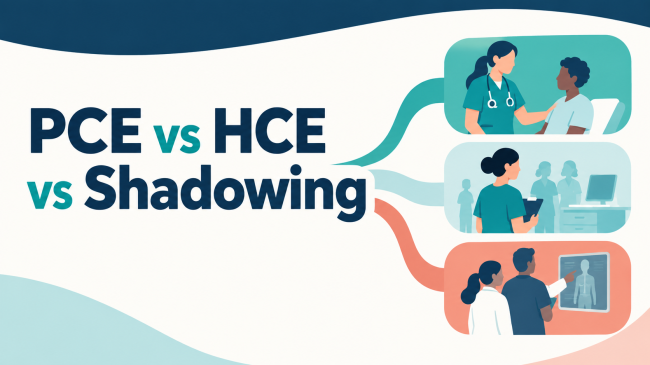
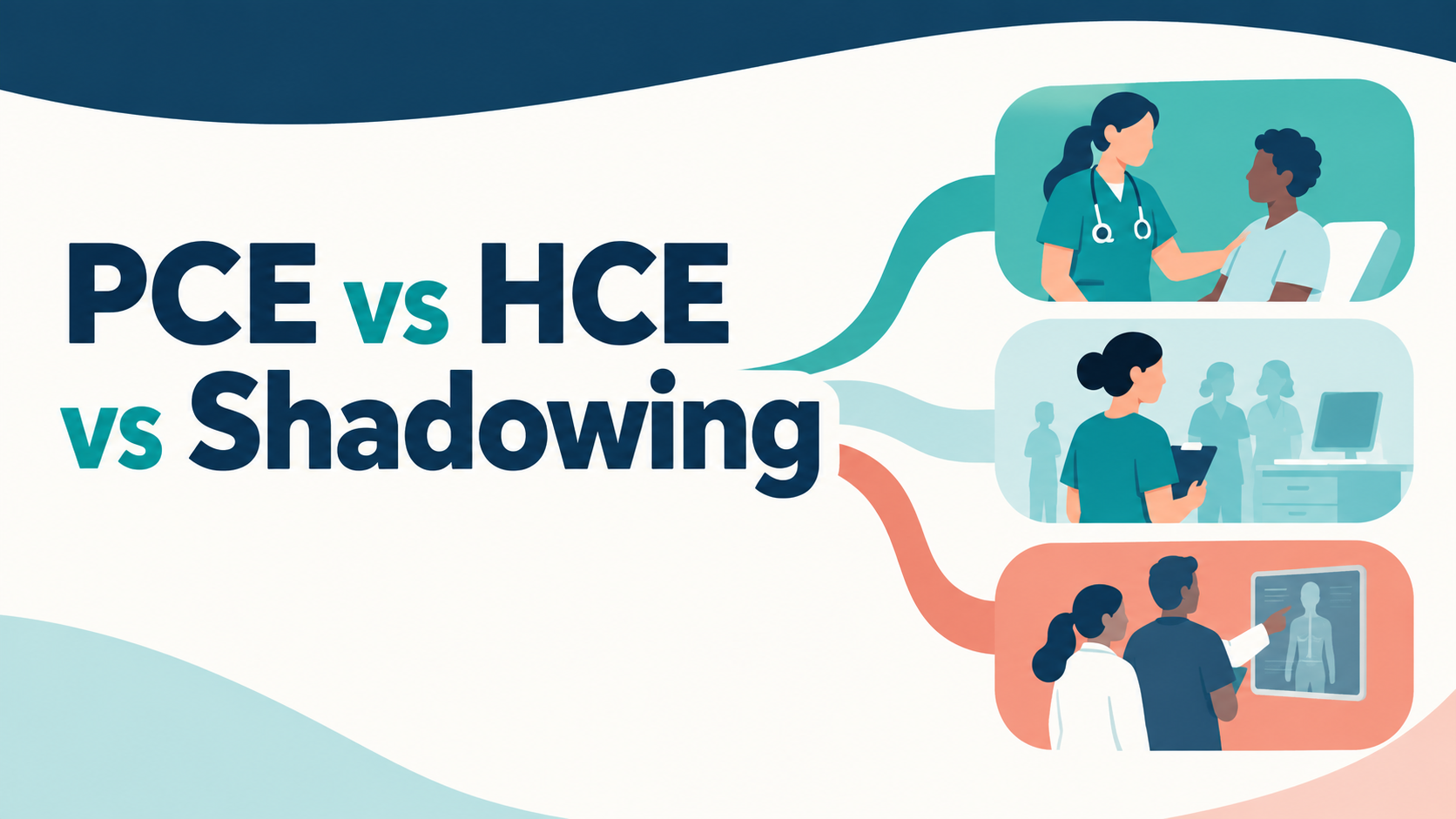
What is the difference between PCE, HCE, and shadowing?
CASPA’s current experience guidance separates the three categories by your level of responsibility for care. It also warns that a program may not accept an experience exactly as you classify it.
| Experience type | What it generally means | What programs may examine |
|---|---|---|
| Patient care experience (PCE) | You are directly responsible for part of a patient’s care. | Hands-on duties, clinical responsibility, procedures, treatment support, patient assessment, and supervision. |
| Healthcare experience (HCE) | You work in a health-related setting but are not directly responsible for a patient’s care. | Patient interaction, healthcare exposure, documentation, workflow, communication, and how much of the role is clinical versus administrative. |
| Shadowing | You follow and observe a healthcare professional at work, preferably a PA. | Whether it was required, the profession or specialty observed, the number of hours, and what you learned about PA practice. |
This framework is useful, but it is not a universal admissions rulebook. A program can set a minimum number of hours, exclude certain roles, give partial credit, prefer paid work, accept volunteer care, or review your duties individually.
Why is a job title not enough?
Medical assistant, CNA, scribe, patient care technician, EMT, phlebotomist, and clinical research coordinator are common pre-PA roles. None of those titles tells an admissions committee exactly what you did.
A medical assistant who rooms patients, takes vitals, administers injections, performs EKGs, and assists with procedures has a very different job from a medical assistant whose work is mostly scheduling and insurance forms. A CNA may provide direct bedside care in one setting but have a narrower scope in another. Some programs count scribing as HCE; others evaluate the duties more generously; others specifically exclude it from a PCE minimum.
Use duties as your evidence. Record what you did with patients, how independently you worked, which procedures you performed, who supervised you, and how many hours were devoted to each kind of work.
A weak description says, “Worked as a medical assistant in primary care.” A stronger description says, “Roomed adult patients, recorded vitals and medication histories, performed EKGs and point-of-care testing, prepared procedure rooms, and documented visit information under clinician supervision.”
The second version gives a program enough detail to apply its own definition.
Which PA programs do not require a minimum number of PCE hours?
The live table below is pulled from the same verified program data that powers PA School Finder. It updates as our directory is updated, so you are not relying on a frozen list from the date this article was published.
“No minimum” means the program says it will not screen you out for having zero required hours. It does not mean experience is ignored, that admitted students have no experience, or that every job will be viewed the same way. Confirm the current policy on the program’s own admissions page before applying.
You can also browse PA programs by healthcare and patient-care experience requirement, including lower-hour and experience-heavy options.
Does shadowing count as PCE?
Usually, no. Shadowing is observation. PCE involves responsibility for care. Shadowing can help you understand the PA role, talk intelligently about team-based practice, and confirm that the profession fits you, but it normally does not replace hands-on experience.
There are exceptions and unusual policies. A program may pool several experience types, award points for shadowing, require a specific number of PA shadowing hours, or accept other exposure when in-person shadowing is difficult. The program’s written policy controls.
Use our always-current list of PA programs that do not require shadowing to see the live breakdown between required, recommended, and not-required policies.
What if one job includes both PCE and HCE duties?
Split the hours honestly. CASPA says applicants should not repeat the same hours across experience categories. If a 40-hour week includes roughly 30 hours of direct patient care and 10 hours of research or administrative work, enter the appropriate duties and hours under the matching categories rather than claiming 40 hours in both.
A practical way to do this is to review a typical week and estimate the average time spent on each duty. Save a copy of your job description, keep a simple hours log, and identify a supervisor who can verify the work.
How should I ask a PA program whether my experience counts?
First, read the program’s admissions page and FAQ. If the answer is still unclear, send a short question that describes your duties. Avoid sending only the job title.
Subject: Clarification about patient care experience
Hello, I am preparing to apply to your PA program and would appreciate clarification about whether my current role may satisfy your patient care experience requirement.
I work as a [job title] in [setting]. My primary duties are [two or three specific duties]. I spend approximately [hours] per week performing these duties under the supervision of [role]. Would this experience be classified as PCE, HCE, or another category for your admissions review?
Thank you for your guidance.
Keep the reply. Program policies can change, and a written answer gives you a record of how the school advised you for that cycle.
How can I audit my experience before applying?
- List every role. Include paid work, volunteer clinical work, military medical service, research, and shadowing.
- Break each role into duties. Separate hands-on care from observation, clerical work, research, or general healthcare exposure.
- Calculate hours without overlap. Use actual dates, average weekly hours, and reasonable splits for mixed roles.
- Compare program by program. Note each school’s minimum, accepted roles, exclusions, recency rules, and whether hours must be complete when you submit.
- Ask about ambiguity before paying. A brief admissions email is cheaper than an application to a program that will not count your experience.
- Verify again before submission. Requirements can change between cycles.
Common questions about PCE, HCE, and shadowing
Is scribing PCE or HCE?
CASPA lists scribing as an example of HCE, but individual PA programs may classify or value it differently. Check each program’s own accepted-role language rather than assuming.
Do volunteer clinical hours count?
They can. Some programs accept paid or volunteer direct care, while others place conditions on the setting, duties, supervision, or how the hours were earned. “Volunteer” describes compensation; it does not automatically describe the level of patient responsibility.
Do clinical hours earned during a training program count?
Sometimes they do not. Programs may exclude hours completed for academic credit, licensure, certification, or a required clinical rotation. Look for this rule specifically.
Is more PCE always better?
More qualified experience can strengthen an application, but hours are only one part of program fit. GPA, prerequisites, recommendations, mission alignment, service, and the quality of your responsibilities can all matter. A large number does not rescue hours a program will not accept.
What is the bottom line?
Do not ask only, “Do I have enough hours?” Ask whether the work you performed matches the definition each program uses.
CASPA gives you categories. PA programs decide eligibility. Your job is to describe your duties clearly, avoid double-counting, and build a school list around policies you have actually verified.
Ready to compare your options? Use PA Program Match to layer experience requirements with GPA, prerequisites, tuition, location, deadlines, and other factors that matter to your application.