
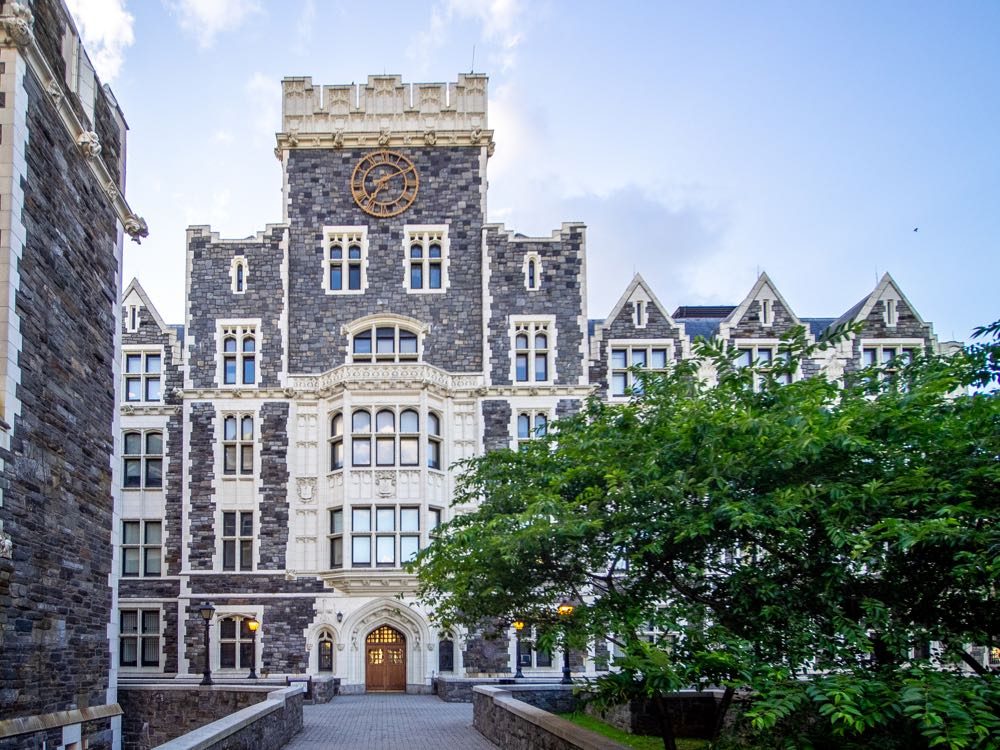
The CUNY School of Medicine (formerly CCNY Sophie Davis School of Biomedical Education) Physician Assistant Program
New York, New York · Master of Science in Physician Assistant Studies
Fees not published
2026–2027 published rates; full total for the entering cohort is unconfirmed
A closer look
A full-time, 28-month PA program in New York City with an 80-credit curriculum spanning classroom medicine, research and clinical rotations. Its mission emphasizes primary care in communities with healthcare-provider shortages. The program currently holds Accreditation-Probation.
Mission & approach
Prepare skilled, compassionate PAs to improve community health and address gaps in primary-care access through education, mentorship and service.
Check my fit with this school
Check three basics
Enter any GPA or patient care hours you know. We’ll compare them with this school’s published numbers. This is a starting point, not an eligibility decision.
The quick check needs JavaScript.
Admissions insights
What this program looks for in applicants
Holistic review considers academic performance, references, statements and CASPA program essays, healthcare experience, commitment to the program mission, an on-site written essay, and an interview. The program emphasizes primary care and communities with healthcare-provider shortages. The program says no group or individual is favored. Mission fit does not guarantee admission.
Summarized from the program’s admissions information. Confirm current selection criteria with the program.
Program admissions informationHow this program interviews
The program requires in-person interviews and an on-site written essay. The interview is described as traditional; individual, group or MMI (multiple mini-interview) format is not otherwise specified. Interviews are scheduled on a rolling basis, which does not mean rolling admission. Travel and accommodation are your responsibility.
Source checked Sep 13, 2026. Interview formats and dates can change between cycles.
Program interview informationAdmissions & prerequisites
Admission requirements
Prerequisite coursework
Semester creditsReview each course, its lab, and the program’s policies. Your links are planning records; the program decides equivalency.
Courses shown as alternatives in the table are not all required. Confirm the accepted route with the program.
- Course choice: Cell and/or Molecular Biology — advanced option + Genetics — advanced option OR Cell and/or Molecular Biology — advanced option + Anatomy and Physiology I — part of advanced option + Anatomy and Physiology II — part of advanced option OR Genetics — advanced option + Anatomy and Physiology I — part of advanced option + Anatomy and Physiology II — part of advanced option
| Course | Credits | Lab | Min grade |
|---|---|---|---|
Biology I and IICourse notes & alternativesRequired two-course sequence. No seven-year limit is stated. | 8semester credits | Required | Minimum grade C; B if the course is still pending. |
General Chemistry I and IICourse notes & alternativesRequired sequential general chemistry courses; organic chemistry I/II cannot substitute. No seven-year limit is stated. | 8semester credits | Required | Minimum grade C; B if the course is still pending. |
MicrobiologyCourse notes & alternativesRequired within seven years before application. | 3semester credits | Required | Minimum grade C; B if the course is still pending. |
StatisticsCourse notes & alternativesAny three-credit statistics course; calculus cannot substitute. Within seven years before application. | 3semester credits | Not specified | Minimum grade C; B if the course is still pending. |
Organic Chemistry ICourse notes & alternativesNewly required as a separate course for 2026–2027; must be within seven years before application. | 4semester credits | Required | Minimum grade C; B if the course is still pending. |
BiochemistryCourse notes & alternativesRequired separately for 2026–2027; no longer one of the advanced-science choices. Must be within seven years. The admissions table does not mark a lab, but the course description mentions laboratory exercises, so confirm lab equivalency rather than assuming none is needed. | 3semester credits | Not specified | Minimum grade C; B if the course is still pending. |
| Cell and/or Molecular Biology — advanced option Choose two advanced options. Cell & Molecular Biology, Cell Biology or Molecular Biology satisfies this one option. Within seven years. | 3semester credits | Not specified | Minimum grade C; B if the course is still pending. |
| Genetics — advanced option Choose two advanced options; genetics is one option, not independently mandatory for everyone. Within seven years. | 3semester credits | Not specified | Minimum grade C; B if the course is still pending. |
| Anatomy and Physiology I — part of advanced option A&P I plus II with labs totals eight credits (four per half) and counts as ONE advanced option. Neither course is mandatory if you choose cell/molecular biology and genetics. Must be within seven years. | 4semester credits | Required | Minimum grade C; B if the course is still pending. |
| Anatomy and Physiology II — part of advanced option Complete with A&P I for the eight-credit option; this pair is one of the two required advanced choices. Within seven years. | 4semester credits | Required | Minimum grade C; B if the course is still pending. |
Policies that can change your plan
- Advanced sciences — choose two
- For the 2026–2027 cycle, biology I–II and general chemistry I–II with labs are required, plus microbiology with lab, statistics, organic chemistry I with lab and biochemistry. Choose TWO advanced options: cell/molecular biology, genetics, or the entire A&P I–II lab sequence (the two-course sequence counts as ONE option). Biochemistry is now required separately, and mammalian physiology is no longer required. Chemistry must be sequential; organic chemistry cannot replace the general chemistry sequence. C or higher is the normal course minimum; pending courses need B or higher. The seven-year rule applies to microbiology, statistics, biochemistry, organic chemistry I and the chosen advanced sciences, but not expressly to general biology or general chemistry.
- Pending courses and degree
- At application, no more than two prerequisites may be outstanding and transcripts must label them in progress. Finish pending prerequisites with B or higher by December 31, 2026. Winter December 2026–January 2027 intersession and Spring 2027 prerequisites are not accepted. Pending grades are not recalculated into the submitted GPA. The bachelor’s degree is due June 15, 2027; pending Spring 2027 non-prerequisite courses also need B or higher.
- Online labs and COVID exceptions
- Online or hybrid lectures taken before Spring 2020 can count, but online labs from before Spring 2020 cannot. Online courses and labs from 2020–2022 are accepted. From Spring 2023 onward, labs must be in person. The course-description PDF requires hands-on, supervised physical labs, not online, virtual or simulated labs. The main admissions page's dated COVID exceptions still apply.
- AP, CLEP and pass/fail
- AP prerequisite credit is considered individually with an AP score of 4 or 5 and score reports uploaded to CASPA. CLEP is not accepted. Pass/fail prerequisite grades generally are not accepted, with an explicit Spring 2020 COVID exception. AP credit is different from advanced placement in the professional PA curriculum.
- No advanced standing
- No prerequisite substitutions, course waivers or advanced placement into the professional curriculum. Transfer credit from another PA or medical program cannot replace the required PA curriculum.
- Patient-care roles
- The official experience guide ranks direct clinical work (for example CNA, EMT, nurse, phlebotomist, respiratory therapist, and scribe with medical-assistant duties) highest. It labels healthcare support and healthcare-environment roles separately; a listed role does not mean all its hours count as direct care. Paid and volunteer experience may both be considered. Describe patient contact, responsibility, skills, supervision and population served. Experience within the last five years is recommended, but no mandatory expiration is stated.
- Recommendation letters
- Three letters are required. For a competitive application, the program advises a letter from a physician or PA with first-hand knowledge of you, and incomplete applications are not reviewed. It is not fully clear whether the clinician letter is required or recommended, so get one or confirm with admissions. A PA letter specifically is not required, because a physician is an alternative.
- English-language testing
- English testing is conditional. The current admissions page gives TOEFL iBT 75 in one section and 80 in another; both give paper TOEFL 550 and IELTS Academic 6.5. The separate requirements page gives iBT 75 and lists exemptions for U.S. citizens/permanent residents, U.S. graduate degrees, or four full-time U.S. semesters. Confirm the iBT threshold and exemption that apply to you before testing. No test-age limit is stated.
- Seat deposit
- The $250 deposit is due within the timeframe in your acceptance offer and is nonrefundable. Whether it is credited toward tuition is not confirmed, so check before treating it as an extra cost.
- Clinical placements
- Ten five-week clerkships include internal medicine, pediatrics, obstetrics/gynecology, psychiatry, primary care, emergency medicine, surgery, geriatrics, critical care and an elective. The program obtains sites and preceptors; students are not required to locate them. Current requirements say clinical rotations are in New York. Some teaching/clinical encounters may use approved online, hybrid or supervised telemedicine methods; this is not a distance-degree option.
- Schedule and employment
- Full-time only; no part-time, evening, or weekend option. Classes are generally Monday–Friday, 8 a.m.–6 p.m., with occasional longer days. Employment is discouraged. Students may not substitute for instructional, administrative, or clinical staff.
- Enrollment requirements
- Background checks, health clearance, immunizations and applicable clinical-site drug screening are required. A site’s denial can prevent completion. Consult the current program policies for exact clearance requirements, costs, accommodations and technical standards.
- Attrition and graduation rates
- The program's attrition table covers graduating classes 2024, 2025 and 2026: entering/graduates of 33/32, 38/34 and 30/28; attrition of 6.1%, 10.5% and 6%; and graduation of 93.9%, 89.5% and 93.3%. The 2024 counts do not match its stated graduation rate, and the 2026 attrition figure does not add up to its graduation rate. Corrected rates are not published, so check with the program.
- Information sessions
- Individual advising and preliminary transcript review are available through the information-session process. Contact [email protected] for upcoming dates; no next session date is published.
- PANCE results timing
- The NCCPA report dated May 5, 2026 lists the Class of 2026 with 25 first-time takers and a 96% pass rate, as of that date; this is not a completed 2026 result. The five-class average for 2022–2026 is 82%. The report's national 2026 rate will not be available until early 2027, so no national comparison is shown.
For the 2026–2027 cycle, biology I–II and general chemistry I–II with labs are required, plus microbiology with lab, statistics, organic chemistry I with lab and biochemistry. Choose TWO advanced options: cell/molecular biology, genetics, or the entire A&P I–II lab sequence (the two-course sequence counts as ONE option). Biochemistry is now required separately, and mammalian physiology is no longer required. Chemistry must be sequential; organic chemistry cannot replace the general chemistry sequence. C or higher is the normal course minimum; pending courses need B or higher. The seven-year rule applies to microbiology, statistics, biochemistry, organic chemistry I and the chosen advanced sciences, but not expressly to general biology or general chemistry.
When courses must be complete: Up to two prerequisites can be in progress at application; finish them with B or higher by December 31, 2026. No winter intersession or Spring 2027 prerequisite completion. Degree conferral is due June 15, 2027. See the separate GPA and course-grade rules.
Dates & application steps
For August 2027 entry, CASPA opened July 1, 2026. Your application must be complete and Verified by December 1, 2026 at 11:59 p.m. Eastern, and the program asks you to allow at least four weeks for verification. Up to two prerequisites may be pending, with separate completion rules. The program says it does not use rolling admission, although interviews are scheduled on a rolling basis.
Program-specific opening, not the general CASPA opening date.
Up to two in progress; B or higher required. No winter intersession courses.
For August 2027 entry; pending spring non-prerequisites also require B or higher.
The exact day is not published.
In person. The requirements page still lists 2026 dates, and exact 2027 interview dates are not published, so check with the program.
The main page gives an annual pattern. The dated 2026 schedule on the requirements page is from a past cycle.
Know what the total includes
Published cost estimate
2026–2027 published rates; full total for the entering cohort is unconfirmed$855 credit × 80 required credits · Estimate at published nonresident rate
For 2026–2027, resident tuition is $5,545 per semester and nonresident tuition is $855 per credit, plus a $955.95 fee line. These are not full-program totals. Another listing shows $40,000 resident and $70,000 nonresident tuition without a stated cohort or calculation. The 80-credit curriculum spans seven terms, including summer and a nine-credit final term; billing rules and later-year rates can change. Ask the program for an individualized estimate.
See additional expenses & assumptions
The program lists a $955.95 fee for each residency category but does not say how often it is billed, so do not multiply it by seven without confirming. General university fees differ from this PA-specific line, and program-wide fees and tuition-plus-fees totals are unconfirmed. The living-budget figures are alternatives for each year: choose one housing arrangement per year rather than adding both. Year 1 covers nine months, year 2 twelve, and year 3 seven. Loan-origination costs are listed as "Average" without a number and are not included in any total. All figures can change.
Curriculum & clinical training
Didactic
Basic/preclinical medicine and professional studies. The catalog lists first-year fall 13 credits, spring 14 and summer 14.
Research
Required research courses and capstone. The catalog places its nine-credit research term in the final fall semester.
Clinical
Ten five-week clerkships, totaling 30 catalog credits, including one elective.
The catalog totals 80 credits across seven terms. The program overview describes the phases as didactic, research and clinical, but the course catalog places clinical coursework in year 2 and research in the final fall, so the order of phases is unclear. Check the schedule for your entering cohort.
The admitted class
Overall and science GPA and healthcare-experience averages for the admitted class are not published. The estimated incoming class for August 2027 is 35, and the ARC-PA maximum is 45. Graduating classes 2024, 2025 and 2026 had 33/32, 38/34 and 30/28 entering/graduating students, but the published attrition and graduation rates do not match those counts, so check with the program for corrected figures.
Published class statistics describe the named cohort or population. They are not admission minimums or acceptance probabilities.
The program’s track record
Graduate outcomes
PANCE pass rates
See first-time program performance with clearly dated national context.
- First-time PANCE pass rate: 96%
The May 5, 2026 NCCPA report labels its latest row Class 2026, graduation year 2026: 25 first-time takers and 96% passing. Its published five-class average is 82% for source-labeled 2022–2026 classes. These are the report’s cohort labels and results as of May 5, not a completed 2026 calendar-year result or a newly inferred graduation date. The report’s national 2026 row says 92% while its footnote says the 2026 national rate will be available in early 2027; that conflicting national figure is not used.
- Five-year first-time PANCE pass rate: 82%
Accreditation history
Probation- September 2024Accreditation-Probation
ARC-PA imposed probation after finding 21 areas of noncompliance involving oversight, staffing, student records, clinical learning/evaluation and self-assessment. Maximum class size remained 45.
- September 2025Additional information requested
ARC-PA requested further evidence on staffing, faculty appointments and timely evaluation of clinical learning; other listed report items required no further information.
- July 2026Report decision deferred
Decision deferred to the October 2026 probation review, which will consider the results of the focused probation visit. This is not removal of probation.
The program is on ARC-PA Accreditation-Probation. The next review is October 2026, and the maximum class size is 45. In July 2026 ARC-PA deferred a report decision until that probation review. The program website still says September 2026, but the newer ARC-PA record says October. Probation is an accreditation status, not proof that accreditation has been withdrawn.
Sources you can open
Links to the program’s own pages and the official directories we use.
- CUNY School of Medicine — prereq-pdf
- CUNY School of Medicine — experience-pdf
- CUNY School of Medicine — curriculum
- CUNY School of Medicine — requirements
- CUNY School of Medicine — costs
- CUNY School of Medicine — program-accreditation
- CUNY School of Medicine — admissions
- CUNY School of Medicine — faq
- CUNY School of Medicine — attrition
- CUNY School of Medicine — policies
- CUNY School of Medicine — sessions
- CUNY School of Medicine — overview
- CUNY School of Medicine — pance
- CUNY School of Medicine — paea
- CUNY School of Medicine — accreditation
- CUNY School of Medicine — summer
- CUNY School of Medicine — bursar
About the U.S. News rank
The U.S. News PA rank uses the 2025 PA edition, matched to the listed program and campus. It reflects peer-assessed reputation, not admissions odds or a personal fit score. Programs without a separate entry are labeled “Unranked.”
How competitive are you for this program?
Match AI compares your full profile with this program and every other one, then sorts your list into Reach, Target and Safety.