Short answer: the best PA school is an accredited program that prepares you well, publishes clear outcomes, and fits your finances, location, and learning needs. A national ranking can help you discover programs, but it should be one input in your decision.
When someone asks me which PA school is “best,” I want to know what they need from it. A famous program across the country may be a worse choice than a strong local program if the difference means another six figures of debt or years away from family.
What do PA school rankings actually measure?
Rankings depend on their methodology. Some emphasize reputation surveys; others use graduation outcomes, selectivity, cost, or a publisher’s own weighting. Two lists can disagree because they are answering different questions.
Before using a ranking, look for a published method, the year of the underlying data, the programs included, and the treatment of missing information. If the method is unclear, the position is difficult to interpret.
A directory listing, paid promotion, or “featured” placement is also different from an educational quality assessment. Ask what earned the position.
How should you compare the best PA schools for you?
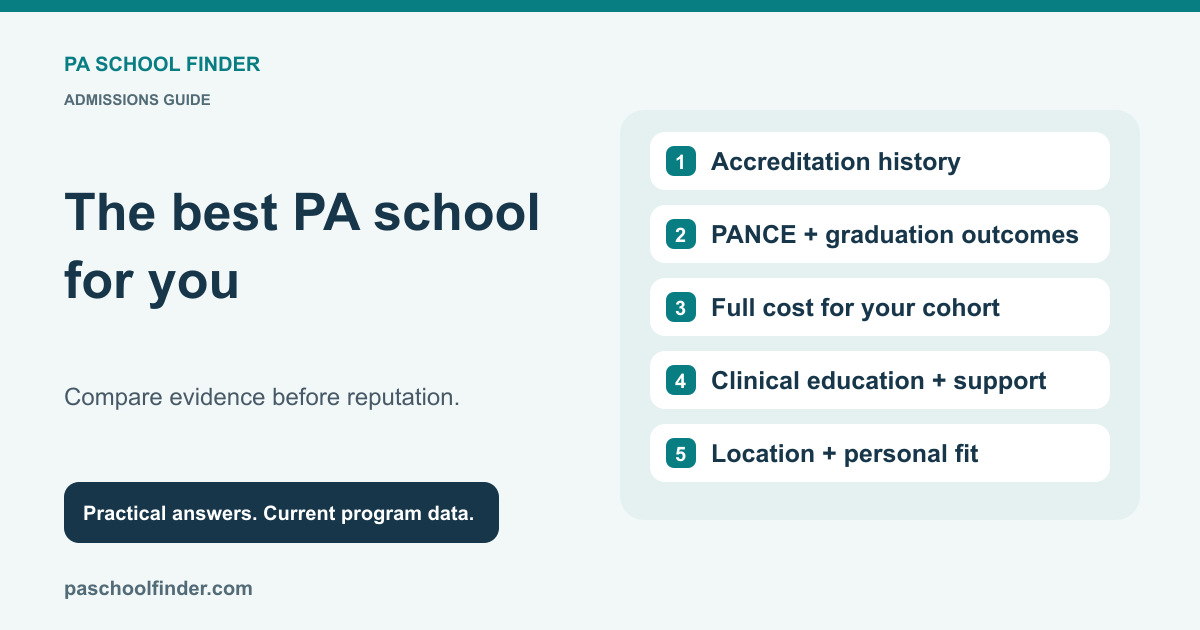
I would use the following comparison in this order. The first two deserve attention before reputation.
- Accreditation: verify the exact program and campus in ARC-PA’s current directory, then open its accreditation history.
- Outcomes: review first-time PANCE results, five-year results when available, graduation or attrition data, and the number of students behind each percentage.
- Total cost: compare tuition, required fees, living expenses, clinical travel, and borrowing needs for the entering cohort.
- Clinical education: ask how rotations are arranged, where students travel, what happens when a site falls through, and which settings align with your interests.
- Student support: ask about academic help, remediation, advising, disability accommodations, and access to faculty.
- Fit: consider teaching format, class size, mission, campus culture, location, and your household’s needs.
Which PA schools have strong PANCE pass rates?
PANCE outcomes are useful because they describe a concrete milestone: passing the national certification examination. They still need context. A 100% result from a small class and a 100% result across hundreds of graduates carry different amounts of evidence.
The live directory list below identifies programs recorded with a 100% five-year PANCE result. It is an outcomes list, not a complete ranking of educational quality.
Check the linked program’s official PANCE report for the years, candidate counts, and whether the rate is first-time or ultimate. New programs without graduates have no PANCE history; missing data should remain missing.
How should accreditation affect your school choice?
Accreditation is specific to the program. Continued, Provisional, and Probation are different statuses, and a university with multiple campuses may have different histories at each one.
Provisional status is part of the process for a new program. Probation warrants careful review of the program’s history and response. Neither label alone provides a complete picture of the student experience.
Read our guides to PA schools on probation and provisional accreditation, then confirm the exact program on ARC-PA.
Can a less expensive PA program be a better choice?
Absolutely. If two programs offer a good educational fit, a substantial cost difference can shape your options after graduation. Lower debt may make it easier to choose a specialty, region, or service role because you want it.
Use our live tuition comparison, then calculate the full cost for your residency status and cohort. Tuition alone leaves out fees, housing, transportation, and clinical travel.
If location flexibility matters, compare hybrid PA programs carefully. Online coursework does not guarantee that all rotations will be near home.
How can you make your own PA school scorecard?
Give each finalist a short evidence sheet. Record the accreditation status, official outcomes link, cohort cost, clinical travel policy, support services, and your reason for choosing it. Use the same fields for every program.
Then choose a few priorities that matter most to you. If location is essential, treat it as a requirement. If minimizing debt is your priority, compare the complete attendance budget. Avoid hiding a deal-breaker inside an average score.
PA Program Match and PA Program Match AI can help you identify candidates. Your final decision should combine the data with direct questions to the program and, when possible, current students.
What should you ask before accepting a seat?
- Where can I review the latest PANCE, graduation, and attrition reports?
- What is the full cost for my entering class and residency status?
- How are clinical placements assigned, and what travel should I expect?
- What support is available when a student struggles academically?
- What has changed in response to the most recent accreditation review?
- Can I speak with a current student about a typical week?
Frequently asked questions
What is the number-one PA school?
The answer depends on the ranking and its methodology. A top reputation position does not establish the best financial, geographic, or learning fit for every applicant.
Do employers care where you went to PA school?
School relationships can matter in particular settings, but a ranking alone does not tell you how an employer will evaluate you. Ask programs about clinical networks, graduate employment, and regional relationships.
Is a 100% PANCE rate enough to choose a program?
No. Review the years and class sizes behind the percentage, along with graduation outcomes, accreditation, clinical education, support, and cost.
A good school decision should still make sense after you cover up the ranking number.
How this guide is maintained: This is a transparent comparison framework, not a claimed national quality ranking. The PANCE list reads the current directory; exact reporting years, denominators, accreditation history, and costs should be checked at the linked official sources.
Stephen Pasquini, PA-C
About PA School Finder and our editorial approach