
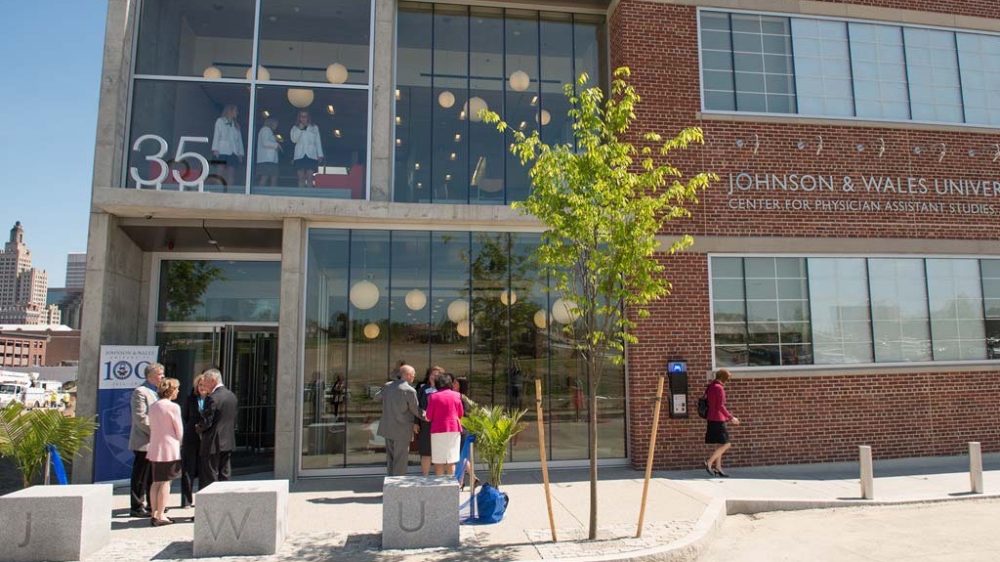
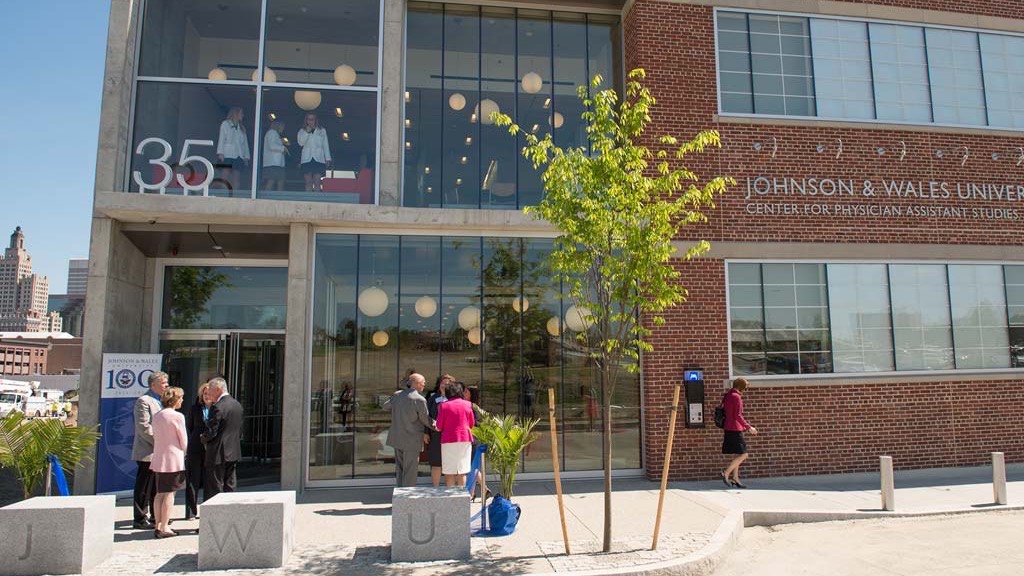
Johnson & Wales University Physician Assistant Program
Providence, Rhode Island · Masters
Tuition + fees $123,721
June 2026 cohort two-year tuition and required program/equipment fees
A closer look
Providence PA program with a preclinical didactic first phase followed by a clinical year of rotations at off-campus sites.
Mission & approach
To educate students to become collaborative practitioners with the respect, empathy and trust inherent to patient-centered, humanistic health care.
Check my fit with this school
Check three basics
Enter any GPA or patient care hours you know. We’ll compare them with this school’s published numbers. This is a starting point, not an eligibility decision.
The quick check needs JavaScript.
Admissions insights
What this program looks for in applicants
Rolling admissions; interview preference for higher GPAs (cumulative and BCP), rigorous upper-level science coursework beyond prerequisites, more/higher-quality PCE hours, more PA shadowing, stronger personal statements and references, stronger mission match, and articulation-agreement candidates. On-campus interview assesses interpersonal/communication skills and commitment to the PA profession.
Summarized from the program’s admissions information. Confirm current selection criteria with the program.
How this program interviews
The on-campus interview assesses interpersonal and communication skills.
Source checked Jul 12, 2026. Interview formats and dates can change between cycles.
Admissions & prerequisites
Admission requirements
Prerequisite coursework
Semester credits where listed; otherwise course countsReview each course, its lab, and the program’s policies. Your links are planning records; the program decides equivalency.
Courses shown as alternatives in the table are not all required. Confirm the accepted route with the program.
- Anatomy and physiology route: Human Anatomy & Physiology I and II OR Human Anatomy + Human Physiology
| Course | Credits | Lab | Min grade |
|---|---|---|---|
Biology2 course(s)Course notes & alternativesTwo courses; general Biology I and II satisfy it. Upper-level Biology may also be used; lecture and lab required. | 8Semester credits where listed; otherwise course counts | Required | C |
MicrobiologyCourse notes & alternativesListed as a separate required course. Credits and lab requirement are not stated. | Not publishedSemester credits where listed; otherwise course counts | Not specified | C |
GeneticsCourse notes & alternativesListed as a separate required course. Credits and lab requirement are not stated. | Not publishedSemester credits where listed; otherwise course counts | Not specified | C |
Chemistry2 course(s)Course notes & alternativesTwo courses; General Chemistry I and II satisfy it. Organic Chemistry and Biochemistry can also count toward this requirement, but the program does not clearly say which substitutions or credit combinations are accepted. | 8Semester credits where listed; otherwise course counts | Required | C |
| Human Anatomy & Physiology I and II2 course(s) Two courses with labs; alternative route is Human Anatomy with lab (4 credits) plus Human Physiology with lab (4 credits). Must cover all body systems; biology/pre-med-major courses preferred. Animal and exercise physiology not preferred. | 8Semester credits where listed; otherwise course counts | Required | C |
| Human Anatomy Alternative A&P route: Human Anatomy with lab (4 credits) plus Human Physiology with lab (4 credits). Do not combine with the A&P I and II route. | 4Semester credits where listed; otherwise course counts | Required | C |
| Human Physiology Alternative A&P route: Human Anatomy with lab (4 credits) plus Human Physiology with lab (4 credits). Do not combine with the A&P I and II route. | 4Semester credits where listed; otherwise course counts | Required | C |
PsychologyCourse notes & alternativesIntroductory or Abnormal Psychology. If AP credit was awarded for Intro Psychology, an upper-level Psychology course is acceptable. | Not publishedSemester credits where listed; otherwise course counts | Not specified | C |
College-level MathematicsCourse notes & alternativesOne college-level math class; Statistics preferred. | Not publishedSemester credits where listed; otherwise course counts | Not specified | C |
Policies that can change your plan
- Course completion
- At least 35 of 39 credits, including labs, by end of December for following June start; all prerequisites by end of May. Accepted provisionally if courses remain, subject to completion.
- Course policies
- C or better; U.S. regional accreditation; online acceptable if lab rules met; AP/CLEP not accepted for prerequisites.
- GPA minimums
- Overall GPA 3.2 and BCP (biology, chemistry, physics) GPA 3.2, as calculated by CASPA.
- Course age
- No age limit is stated.
JWU lists 39 total credits but does not break them down across all subjects. Microbiology and Genetics are separate required courses. Confirm with the program whether Organic Chemistry/Biochemistry can replace both general chemistry courses or only count toward the 8-credit chemistry requirement.
When courses must be complete: At least 35 of 39 prerequisite credits, including associated labs, by the end of December for the following June start; all remaining work complete by the end of May before classes begin.
Dates & application steps
Your CASPA application must reach “Completed” status by October 1.
Know what the total includes
Published cost estimate
June 2026 cohort two-year tuition and required program/equipment fees$114,342 program + $8,279 program + $1,100 program · Current published rate; future rates may change
Two-year costs: $114,342 tuition, $8,279 in fees and $1,100 in medical equipment fees, for $123,721 total. Student health insurance ($5,814) is separate and may be waived if you have comparable coverage.
Curriculum & clinical training
Preclinical education
Organ-system study integrates physiology, pathophysiology, clinical medicine, evidence-based practice, diagnosis and treatment.
Clinical education
Nine five-week off-campus rotations cover primary care and medical and surgical specialties. A parallel master’s course supports summative assessment and preparation for practice.
The Providence MSPAS is a full-time 24-month graduate program.
The admitted class
Published class statistics describe the named cohort or population. They are not admission minimums or acceptance probabilities.
The program’s track record
Graduate outcomes
PANCE pass rates
See first-time program performance with clearly dated national context.
- First-time PANCE pass rate: 100%
- Five-year first-time PANCE pass rate: 97%
Accreditation history
Accredited-ContinuedSources you can open
Links to the program’s own pages and the official directories we use.
- Johnson & Wales University program page
- Johnson & Wales University program website
- ARC-PA currently accredited programs — sponsoring-institution directory
- Johnson & Wales University curriculum and clinical training
- Johnson & Wales University MSPAS admissions requirements
- Johnson & Wales University program website
About the U.S. News rank
The U.S. News PA rank uses the 2025 PA edition, matched to the listed program and campus. It reflects peer-assessed reputation, not admissions odds or a personal fit score. Programs without a separate entry are labeled “Unranked.”
How competitive are you for this program?
Match AI compares your full profile with this program and every other one, then sorts your list into Reach, Target and Safety.