Short answer: direct-entry PA programs offer a pathway into PA education before the usual post-bachelor’s application stage. Many combine undergraduate study with a professional PA phase, but the meaning of “direct entry,” the point of admission, and the conditions for progressing vary by school.
If you are in high school or early in college, these pathways are worth researching. I would read the progression policy before I got attached to the phrase “guaranteed admission.” The conditions are the part that determines whether the pathway works.
What is a direct-entry PA program?
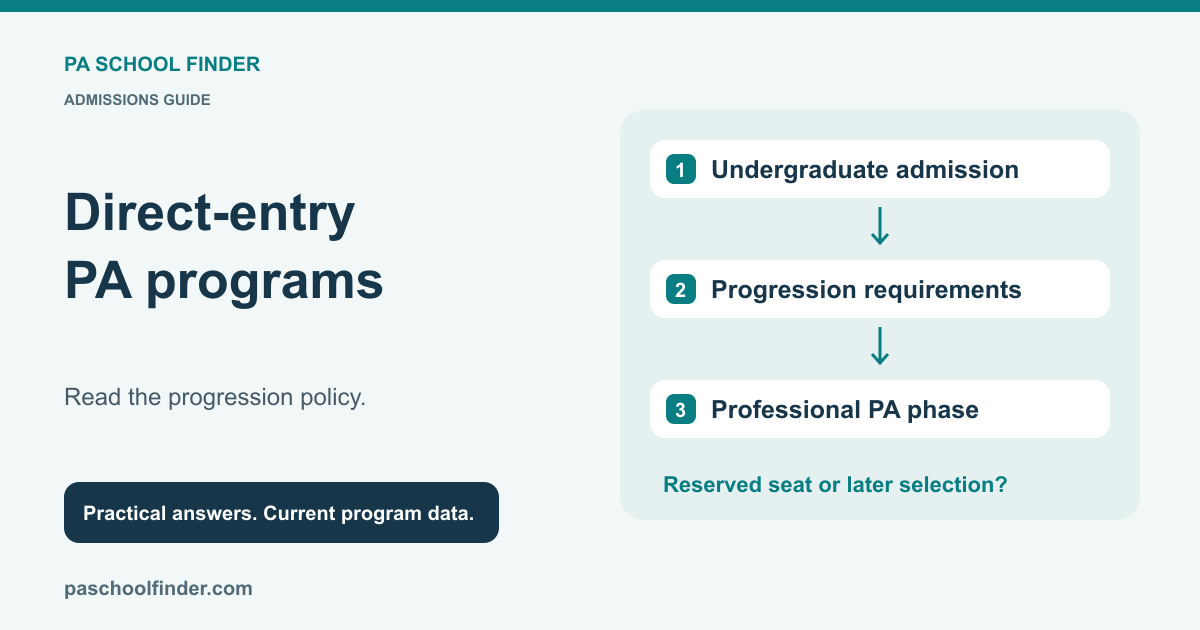
A direct-entry pathway may admit students as freshmen into a combined bachelor’s/master’s track, reserve a place for qualifying undergraduates, or offer an internal early-assurance route. Schools also use terms such as accelerated, combined, 3+2, 4+2, and BS/MS.
Those labels are not interchangeable. One pathway may admit you directly to a reserved professional seat if you maintain all requirements. Another may offer only a preferred interview or eligibility for a later competitive application.
Which PA programs have a direct-entry pathway?
The table below reads the current PA School Finder directory and includes accredited program records marked Direct Entry = Yes. It identifies programs to investigate; it does not establish that a particular undergraduate pathway is open, guaranteed, or available to transfer students.
Loading current directory records…
Open each program’s official website and locate the undergraduate pathway’s current admissions and progression rules. A graduate PA program page may not describe the freshman route.
Is direct entry a guaranteed PA school seat?
Sometimes a school describes a conditional reserved seat, but the word “guaranteed” needs the full policy beside it. Ask whether progression requires a minimum overall or science GPA, specific prerequisite grades, patient-care hours, an interview, a background check, or a separate application.
Also ask whether every student who meets the conditions progresses or whether the professional phase has a second competitive selection. Those are materially different promises.
How long does a combined PA pathway take?
Some pathways are advertised as five years; others take six or more. The number depends on how undergraduate credits and the professional phase are arranged. A familiar “3+2” label should still be checked against the current curriculum.
Ask when you earn the bachelor’s degree, when professional PA tuition begins, whether summer terms are included, and what happens if you need an extra term or leave the pathway.
What requirements should high school applicants compare?
- Initial admission: grades, high school science preparation, testing policy, essay, interview, and application deadline.
- Progression: cumulative/science GPA, course grades, required experience, and conduct standards.
- Seat policy: reserved seat, early assurance, preferred interview, or competitive application.
- Transfer policy: whether transfer students can enter the pathway and at what point.
- Cost: undergraduate and professional tuition, scholarships that end at the professional phase, fees, and housing.
- Exit options: the degree and credits you retain if your plans change.
Keep the answers in writing. If the website is ambiguous, ask admissions to confirm the policy for your expected entering cohort.
What are the advantages and tradeoffs of direct entry?
A structured pathway can offer advising, a clear curriculum, and earlier certainty. It can also tie you to a university, cost structure, and profession before you have much clinical experience.
Spend time observing a PA and working or volunteering in healthcare when possible. It is easier to make a confident commitment when you understand the work, not just the career description.
Compare the pathway with a regular bachelor’s degree followed by a broader CASPA application. That route may take longer or feel less certain, but it can leave more room to choose schools later.
How do you check accreditation for a combined pathway?
Verify the professional PA program’s exact campus and accreditation history in ARC-PA’s accredited-program directory. University accreditation and PA program accreditation answer different questions.
Then ask the university how the undergraduate pathway connects to that specific professional program. Review our PA school comparison framework and tuition guide as you compare finalists.
What should you ask the direct-entry admissions team?
I am considering your PA pathway for the entering class of [year]. If I meet every published undergraduate requirement, am I assured a professional PA seat, assured an interview, or still part of a competitive application? Could you send the current progression policy, full timeline, transfer policy, and undergraduate/professional cost estimates?
Frequently asked questions
Can you enter PA school straight from high school?
You may enter an undergraduate pathway that leads into the professional PA phase. You do not skip the required undergraduate and professional education simply because the pathway is called direct entry.
Can transfer students enter a direct-entry PA program?
Some pathways permit transfers, while others reserve seats for students admitted as freshmen. Confirm the policy with the specific pathway.
Do direct-entry students use CASPA?
The initial undergraduate application and later professional steps vary. Some pathways require CASPA at progression; others use an internal process. Follow the school’s current instructions.
Are direct-entry PA programs easier?
They change when and how selection occurs. Initial admission and progression can both be demanding. Compare the conditions, cost, and fit before treating the pathway as a shortcut.
A direct-entry pathway is most useful when its progression rules are clear and its full educational plan makes sense for you.
How this guide is maintained: The table reads Direct Entry from the published directory and includes accredited records explicitly marked Yes with a valid row date within 45 days. The field identifies research candidates; pathway guarantees, transfer eligibility, and current opening status require direct confirmation.
Stephen Pasquini, PA-C
About PA School Finder and our editorial approach