
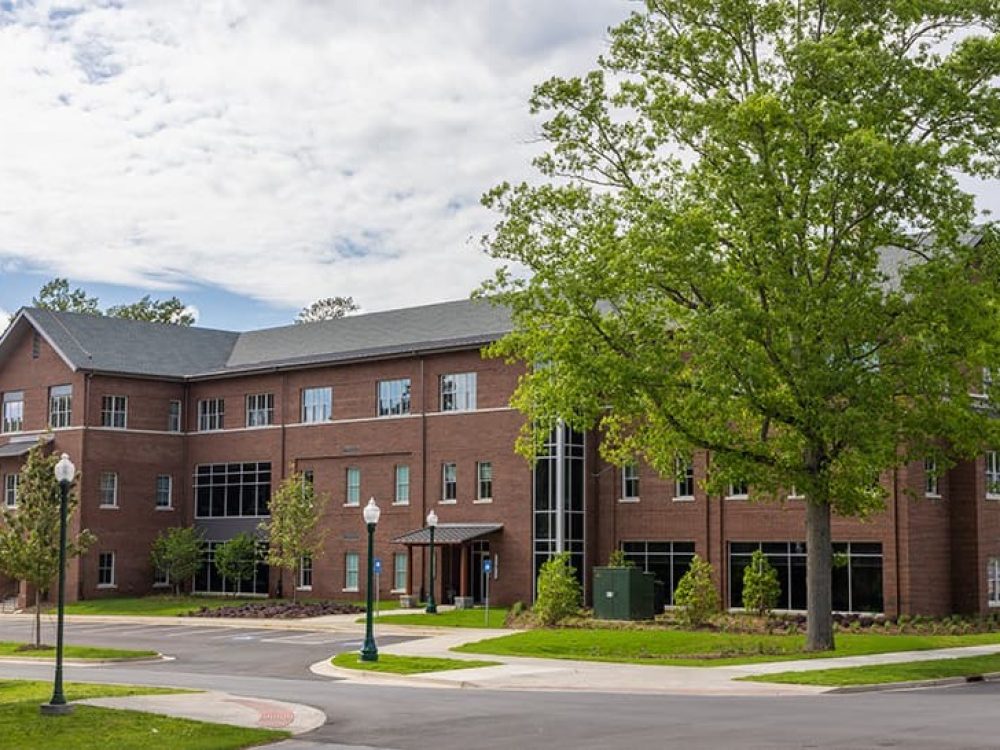
Berry College Physician Assistant Program
Mount Berry, Georgia · Master of Medical Science
Tuition + fees $119,390
Class of 2029 — admitted 2027, two-year program
Check my fit with this school
Check three basics
Enter any GPA or patient care hours you know. We’ll compare them with this school’s published numbers. This is a starting point, not an eligibility decision.
The quick check needs JavaScript.
A closer look
A residential, 24-month Master of Medical Science program in Mount Berry, Georgia, with 127 credits: 81 didactic credits followed by 46 clinical credits. The curriculum includes seven required clinical specialties and an elective.
Mission & approach
Berry prepares future physician associates to provide comprehensive, compassionate and patient-centered care in their communities.
Admissions insights
What this program looks for in applicants
Rolling review uses a rubric, with higher course grades and GPA weighted more heavily. Confirmed Berry students/graduates in good standing, honorably discharged veterans, applicants from medically underserved areas and applicants from Appalachia each receive one preference point with documentation. Meeting minimums or preferences does not guarantee an interview or admission. CASPA personal statements generated in whole or part by AI are not accepted.
Summarized from the program’s admissions information. Confirm current selection criteria with the program.
Program admissions informationHow this program interviews
Required invitation-only, on-campus interview in Mount Berry: two individual faculty/staff interviews, a group discussion, and a handwritten essay. No virtual interviews. One national listing also mentions an MMI (multiple mini-interview)/scenario room, which the program's own description does not.
Source checked Sep 13, 2026. Interview formats and dates can change between cycles.
Program interview informationAdmissions & prerequisites
Admission requirements
Science GPA policy & alternatives
Berry requires a CASPA overall GPA of 3.0, a prerequisite GPA of 3.0, and a science GPA of 3.0 in biology, chemistry and physics (BCP) courses.
Prerequisite coursework
CreditsReview each course, its lab, and the program’s policies. Your links are planning records; the program decides equivalency.
| Course | Credits | Lab | Min grade |
|---|---|---|---|
Human AnatomyCourse notes & alternativesLab required. | 4credits | Required | C |
Human PhysiologyCourse notes & alternativesLab required. | 4credits | Required | C |
General ChemistryCourse notes & alternativesLab required. | 8credits | Required | C |
MicrobiologyCourse notes & alternativesLab policy is not specified. | 3credits | Not specified | C |
BiochemistryCourse notes & alternativesLab policy is not specified. | 3credits | Not specified | C |
Organic ChemistryCourse notes & alternativesLab required. | 4credits | Required | C |
PsychologyCourse notes & alternativesLab policy is not specified. | 3credits | Not specified | C |
StatisticsCourse notes & alternativesLab policy is not specified. | 3credits | Not specified | C |
English composition/writingCourse notes & alternativesLab policy is not specified. | 3credits | Not specified | C |
Policies that can change your plan
- Course recency
- The admissions page and the 2025 handbook specify ten years for current cohorts; the handbook's five-year rule applies only to the Class of 2027. The current FAQ still says five years with no cohort qualifier. Confirm course recency with the program before applying.
- AP/CLEP and advanced placement
- Berry offers no advanced placement or prerequisite waivers. Whether transcripted AP/CLEP credit counts toward admission prerequisites is not published — check with the program.
- Experience
- Healthcare-related experience is required, but Berry states there is no minimum number of hours. Accepted experience may include healthcare, patient care, shadowing and volunteering as CASPA defines them. The admissions page describes 1,000 hours as competitive, while the FAQ and 2025 handbook say 500. Both are broad-experience benchmarks, not direct patient-care minimums. Confirm the competitive benchmark with Berry.
- Letters
- Three letters: one nationally certified and state-licensed PA; one college professor or a supervisor who has worked with you for at least six months; and one healthcare professional such as a physician, nurse or healthcare supervisor. Authors must know your work firsthand. Friends, relatives and your personal healthcare providers are not accepted.
- Tests
- No required standardized tests are listed for August 2027 entry. The 2025 handbook limits the GRE to the Class of 2027 (the graduating cohort, not August 2027 entrants), and current admissions has no GRE requirement, so the GRE is not required for Class of 2029 applicants. PA-CAT and CASPer are not addressed on the current admissions page. TOEFL may be required if your native language is not English, with a minimum total score of 90.
- Selection
- Rolling review uses a rubric, with higher course grades and GPA weighted more heavily. Confirmed Berry students/graduates in good standing, honorably discharged veterans, applicants from medically underserved areas and applicants from Appalachia each receive one preference point with documentation. Meeting minimums or preferences does not guarantee an interview or admission. CASPA personal statements generated in whole or part by AI are not accepted.
- Costs
- Class of 2029 (admitted in 2027): tuition is $59,130 per year, fixed for the cohort, totaling $118,260. Technology ($150), activity ($225) and parking ($160) fees recur each year; graduation adds $60 in year two. Required fees total $1,130 and direct costs total $119,390. Estimated indirect costs are $35,082 in year one and $38,049 in year two, for a two-year attendance estimate of $192,521. All figures are estimates; actual expenses may vary.
- Before matriculation
- AHA Basic Life Support certification and health insurance are required and must continue through the program. Health clearance, immunizations, a national background check and comprehensive drug screen are required; screening costs belong to the student.
- Technology
- A PC laptop with reliable internet is required; Macintosh/Apple computers, tablets and Chromebooks do not meet the published requirement.
- Housing and travel
- Students arrange their own housing and should have access to a personal vehicle. Away rotations can require additional housing; neither AHEC (Area Health Education Centers) nor the program guarantees it.
- Deferrals
- The 2025 handbook says acceptance cannot be deferred; students seeking a later cohort must reapply.
- Graduation and attrition
- Berry says annual graduation and attrition data will be posted by April 1 after the first cohort graduates. No completed-cohort counts or rates are published yet; current enrollment is not an outcome.
Nine prerequisite subjects total 35 credits. Minimum grade is C and the CASPA prerequisite GPA is 3.0; only two may be outstanding at application. Anatomy, Physiology, General Chemistry and Organic Chemistry require labs; other lab policies are not specified. Course recency is unclear: the admissions page and 2025 handbook specify ten years for current cohorts (the handbook's five-year rule applies only to the Class of 2027), but the current FAQ still says five years. Confirm with the program before applying. Genetics (4 credits with lab) appears in a national listing, but the handbook limits it to the Class of 2027 and current admissions does not list it, so it is not shown as required. Medical terminology is recommended, not required.
When courses must be complete: A bachelor’s degree from a regionally accredited institution is due before matriculation. At most two prerequisites may be outstanding when applying; accepted students must meet grade and GPA conditions. Berry’s timeline puts immunizations and outstanding requirements at August 1 before the August start.
Dates & application steps
For August 2027 entry (Class of 2029), the deadline is April 1, 2027. Berry requires a completed, CASPA-verified application by 11:59 p.m. EST on April 1, while another listing says submitted is enough, so check with the program to confirm. The exact opening day is not published (a 2026–27 opening date of April 30, 2025 printed elsewhere is incorrect).
Planned incoming class size is 40; the August 2026 start is a passed cycle.
The cycle year on the program's page is inconsistent (it shows 2025); confirm the cycle in CASPA.
A bachelor’s degree from a regionally accredited institution is due before matriculation. At most two prerequisites may be outstanding when applying; accepted students must meet grade and GPA conditions. Berry’s timeline puts immunizations and outstanding requirements at August 1 before the August start.
Invitations begin in August; offers of admission start in September and continue on a rolling basis.
Know what the total includes
Published cost estimate
Class of 2029 — admitted 2027, two-year programClass of 2029 (admitted in 2027): tuition is $59,130 per year, fixed for the cohort, totaling $118,260. Technology ($150), activity ($225) and parking ($160) fees recur each year; graduation adds $60 in year two. Required fees total $1,130 and direct costs total $119,390. Estimated indirect costs are $35,082 in year one and $38,049 in year two, for a two-year attendance estimate of $192,521. All figures are estimates; actual expenses may vary.
See additional expenses & assumptions
Tuition is $59,130 per year ($118,260 for two years). Fees are $535 in year one and $595 in year two ($1,130). Direct costs are $59,665 and $59,725 ($119,390). Indirect costs are $35,082 and $38,049 ($73,131). Estimated attendance is $94,747 and $97,774 ($192,521). The deposit is credited to tuition and is not added again.
Curriculum & clinical training
Year one: 12 months
Three 27-credit terms covering anatomy and physiology, clinical medicine, pharmacology, clinical skills, clinical application, professional topics, clinical science, evidence-based practice and a didactic seminar.
Year two: 12 months
Forty weeks of supervised clinical practice. Required specialties: family medicine, emergency medicine, pediatrics, internal medicine, women’s health, surgery, and behavioral/mental health. An elective, emerging topics, transition to practice and summative coursework complete the phase.
81 didactic + 46 clinical = 127 credits. The 2025 handbook specifies 40 weeks of supervised clinical experience. Individual rotation lengths are not published — check with the program.
The admitted class
August 2026 accepted class
Published class statisticsOverall GPA 3.72; BCP GPA 3.60; prerequisite GPA 3.74. Applicant pool: 3,359 initiated, 719 verified, 108 interviewed, 34 accepted. Average age 24.32 years, range 22–30.
Compare published cohorts
| Class | Published GPA | Published science-related GPA | Published experience hours |
|---|---|---|---|
| August 2025 accepted class | 3.62 | Not recorded | Not recorded |
| August 2026 accepted class | 3.72 | Not recorded | Not recorded |
Latest class profile, for August 2026 matriculation. August 2025 accepted class: overall GPA 3.62; BCP (biology, chemistry, physics) GPA 3.66; prerequisite GPA 3.54. Applicant pool: 1,345 initiated, 162 verified, 48 interviewed, 28 accepted. August 2026 accepted class: overall GPA 3.72; BCP GPA 3.60; prerequisite GPA 3.74. Applicant pool: 3,359 initiated, 719 verified, 108 interviewed, 34 accepted. Average age 24.32 years, range 22–30. The 2025 class had 23 women and 5 men; the 2026 class had 29 women and 5 men. Another listing shows an older overall average of 3.6 with no class year.
Published class statistics describe the named cohort or population. They are not admission minimums or acceptance probabilities.
The program’s track record
Graduate outcomes
PANCE pass rates
See first-time program performance with clearly dated national context.
- First-time PANCE pass rate: No graduates yet
No graduates yet as of September 2026: the first cohort entered August 2025 in a 24-month program. Berry says annual PANCE information will begin by April 2028. No first-time, five-year, national-comparison, numerator or denominator is available for Berry; unavailable results are not 0%.
First-time program results are not yet available; no graduates have been reported.
- Five-year first-time PANCE pass rate: No graduates yet
Five-year first-time results are not yet available.
Accreditation history
Provisional- March 2025Initial Accreditation-Provisional
ARC-PA set a maximum class size of 40 and noted one staffing-timeline noncompliance under D1.01c. The history does not show a later resolution — check with the program.
- To be determinedNext review
The date of the next accreditation review has not been set yet.
Accreditation-Provisional, first awarded March 2025, with a maximum class size of 40. The date of the next accreditation review has not been set yet. Provisional status does not guarantee later accreditation.
Sources you can open
Links to the program’s own pages and the official directories we use.
- Program-maintained PAEA directory
- ARC-PA indexed program directory (stale; unavailable origin)
- ARC-PA currently accredited programs — sponsoring-institution directory
- ARC-PA Berry accreditation history
- Berry PA Student Handbook, second edition 2025
- Berry PA program FAQ
- Berry program accreditation statement
- Berry College Physician Associate Program Admissions
- Berry graduation-rate reporting page
- Berry PA curriculum
- Berry PANCE performance reporting page
- Berry PA tuition and costs
About the U.S. News rank
The U.S. News PA rank uses the 2025 PA edition, matched to the listed program and campus. It reflects peer-assessed reputation, not admissions odds or a personal fit score. Programs without a separate entry are labeled “Unranked.”
How competitive are you for this program?
Match AI compares your full profile with this program and every other one, then sorts your list into Reach, Target and Safety.