
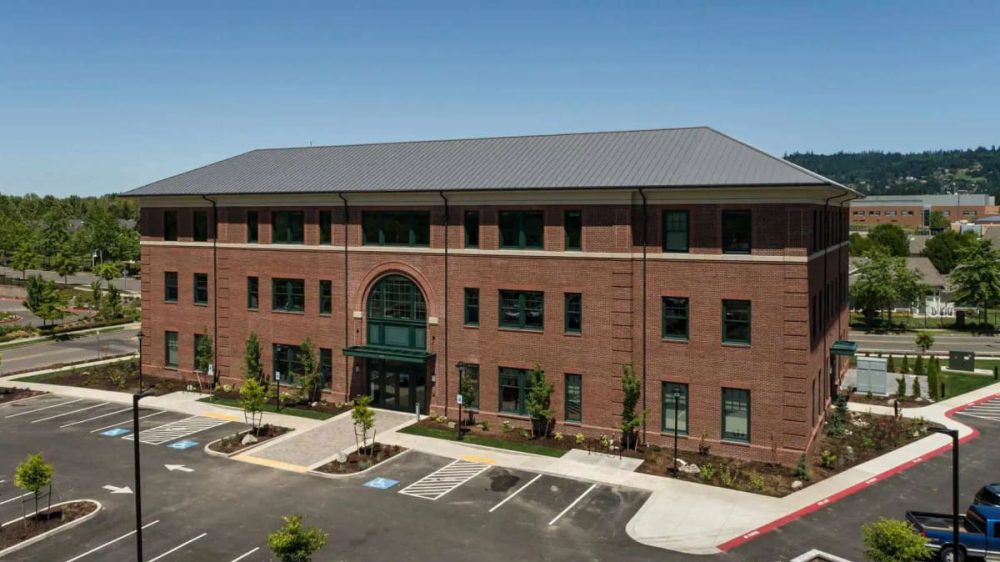
George Fox University Physician Assistant Program
Newberg, Oregon · Physician Assistant program
Tuition + fees $139,373
January 2027 cohort projected full-program tuition
Check my fit with this school
Check three basics
Enter any GPA or patient care hours you know. We’ll compare them with this school’s published numbers. This is a starting point, not an eligibility decision.
The quick check needs JavaScript.
A closer look
Admissions requirements for this PA program.
Mission & approach
See the program's website for its current mission and educational approach.
Admissions insights
What this program looks for in applicants
Scored on overall academic aptitude, prerequisite aptitude (3.0 min cumulative/prereq/BCP; each prereq B-/2.7+), paid healthcare experience (2,000 hrs recommended), volunteerism, and 3 LORs. No standardized test required or considered. Rolling admission with interview rounds; bachelor's degree required by deadline.
Summarized from the program’s admissions information. Confirm current selection criteria with the program.
Program admissions informationHow this program interviews
All interviews are in person at the Medical Sciences Building in Newberg, Oregon. Interview day combines group interviews, an MMI session of short stations, a written essay, and a short panel interview with faculty, staff and trained interviewers.
Source checked Aug 1, 2026. Interview formats and dates can change between cycles.
Program interview informationAdmissions & prerequisites
Admission requirements
Prerequisite coursework
Semester hours (quarter-hour equivalents are listed for each requirement)Review each course, its lab, and the program’s policies. Your links are planning records; the program decides equivalency.
| Course | Credits | Lab | Min grade |
|---|---|---|---|
Human Anatomy & Physiology coursework2 course(s)Course notes & alternatives8 semester hours (or 10 quarter hours). Take two anatomy/physiology courses, or one anatomy course with lab plus one physiology course. A lab is not required. | 8Semester hours (quarter-hour equivalents are listed for each requirement) | Preferred | B- |
General Biology with labCourse notes & alternatives4 semester hours (or 5 quarter hours); lab must coordinate with the lecture. Normally a 200-level course. | 4Semester hours (quarter-hour equivalents are listed for each requirement) | Required | B- |
Other BiologyCourse notes & alternatives3 semester hours (or 4 quarter hours). Choose one: an upper-level Biology course, General Biology II, Genetics, Cell Biology, Immunology, Virology, Epidemiology, or Biochemistry (if Biochemistry is not used for Other Chemistry). Lab not required. Biochemistry can count toward only one requirement. Check course equivalency with the program. | 3Semester hours (quarter-hour equivalents are listed for each requirement) | Not required | B- |
General Chemistry with labCourse notes & alternatives4 semester hours (or 5 quarter hours); lab must coordinate with lecture. Normally a 200-level course. | 4Semester hours (quarter-hour equivalents are listed for each requirement) | Required | B- |
Other ChemistryCourse notes & alternatives3 semester hours (or 4 quarter hours). Choose one: an upper-level Chemistry course, General Chemistry II, Organic Chemistry, Analytical Chemistry, or Biochemistry (if Biochemistry is not used for Other Biology). Lab not required. Organic Chemistry is not specifically required, so ask the program whether your course counts. | 3Semester hours (quarter-hour equivalents are listed for each requirement) | Not required | B- |
MicrobiologyCourse notes & alternatives3 semester hours (or 4 quarter hours). Microbiology for non-science majors and survey/introductory courses are accepted; lab is not required. | 3Semester hours (quarter-hour equivalents are listed for each requirement) | Not required | B- |
PsychologyCourse notes & alternatives3 semester hours (or 4 quarter hours). Accepted: General, Introductory, Developmental Psychology, or Human Growth and Development. AP may be accepted if specific college course credit is posted. | 3Semester hours (quarter-hour equivalents are listed for each requirement) | Not specified | B- |
StatisticsCourse notes & alternatives3 semester hours (or 4 quarter hours). General, Biostatistics, Behavioral Statistics, or Psychology Statistics accepted; Business Statistics not accepted. AP may be accepted if specific college course credit is posted. | 3Semester hours (quarter-hour equivalents are listed for each requirement) | Not specified | B- |
Policies that can change your plan
- A&P laboratory
- Either two anatomy/physiology courses or one anatomy course with lab plus one physiology course works. A lab is not required.
- General chemistry category
- Other Chemistry accepts several subjects, including General Chemistry II. Organic Chemistry is not specifically required. Check with the program whether your course counts.
- Biochemistry double counting
- Biochemistry can satisfy Other Biology or Other Chemistry, but not both. You need two separate courses to cover the two requirement groups.
- Course recency
- All prerequisites must be within 10 years; the 2026 cycle says courses completed before 2016 are not considered.
- Cycle timing
- The September 1, 2026 deadline has passed. The next cycle's deadline is not yet listed.
- International applicants
- Foreign transcripts are evaluated, but all prerequisites must be completed at a regionally accredited U.S. university. A TOEFL score of 5.5 or higher is required for applicants who are not native English speakers and lack a year of English composition.
For the 2026 cycle, all prerequisites must be completed and CASPA-verified by September 1, 2026, and at most one prerequisite may be in progress. No standardized tests are required. There is no minimum number of patient-care hours, but 2,000 paid direct-care hours are recommended. International applicants may apply if their prerequisites were completed at a U.S. regionally accredited institution. The English-language test policy applies only to applicants who meet the language conditions.
When courses must be complete: For the 2026 application cycle, prerequisites must be completed and CASPA-verified by September 1, 2026. At most one prerequisite class may be in progress, and it must be completed by that deadline.
Dates & application steps
September 1, 2026 was the deadline for a submitted and verified CASPA application for the January 2027 cohort, and it has passed. No later deadline is listed, so check CASPA and the program.
Know what the total includes
Published cost estimate
January 2027 cohort projected full-program tuition$77,742 Year 1 + $60,466 Year 2 · Projected; excludes $1,165 university/graduation fees; rates may change
George Fox projects $77,742 for Year 1 and $60,466 for Year 2, for a tuition total of $138,208. That total excludes $1,165 in university and graduation fees. Tuition and fees may change.
Curriculum & clinical training
Didactic phase
On-campus medical instruction uses problem-based learning and clinical skills assessment.
Clinical phase
Supervised hospital and clinic experiences cover core medical and surgical disciplines.
Summative phase
Written assessment, OSCEs and clinical skills testing measure graduate competency.
The Newberg program runs 24 months over six consecutive semesters and 112 graduate credits. The phases add up to 24 months (12 + 11 + 1).
The admitted class
Spring 2026 selected class
Published class statisticsSpring 2026 selected students: cumulative GPA 3.83, biology/chemistry/physics GPA 3.77, prerequisite GPA 3.86, and patient-care experience 3,664 hours. The biology/chemistry/physics GPA is not a general science GPA.
Compare published cohorts
| Class | Published GPA | Published science-related GPA | Published experience hours |
|---|---|---|---|
| Spring 2026 selected class | 3.83Mean Overall/cumulative GPA | 3.77Mean BCP (biology, chemistry, physics) GPA | 3,664Mean Patient care hours |
Published class statistics describe the named cohort or population. They are not admission minimums or acceptance probabilities.
The program’s track record
Graduate outcomes
PANCE pass rates
See first-time program performance with clearly dated national context.
- First-time PANCE pass rate: 97%
No 5-year average yet - only FOUR graduating cohorts (2022-2025); 95% first-time across all four (111/117)
- Five-year first-time PANCE pass rate: Not available yet
Five-year first-time results are not yet available.
Accreditation history
ContinuedSources you can open
Links to the program’s own pages and the official directories we use.
- ARC-PA currently accredited programs — sponsoring-institution directory
- George Fox PA admissions review
- George Fox PA Program Prerequisite Courses Standard
- George Fox University curriculum and clinical training
- PA School Finder contact record
- George Fox PA Program Projected Tuition and Fees
- Program contact page
About the U.S. News rank
The U.S. News PA rank uses the 2025 PA edition, matched to the listed program and campus. It reflects peer-assessed reputation, not admissions odds or a personal fit score. Programs without a separate entry are labeled “Unranked.”
How competitive are you for this program?
Match AI compares your full profile with this program and every other one, then sorts your list into Reach, Target and Safety.